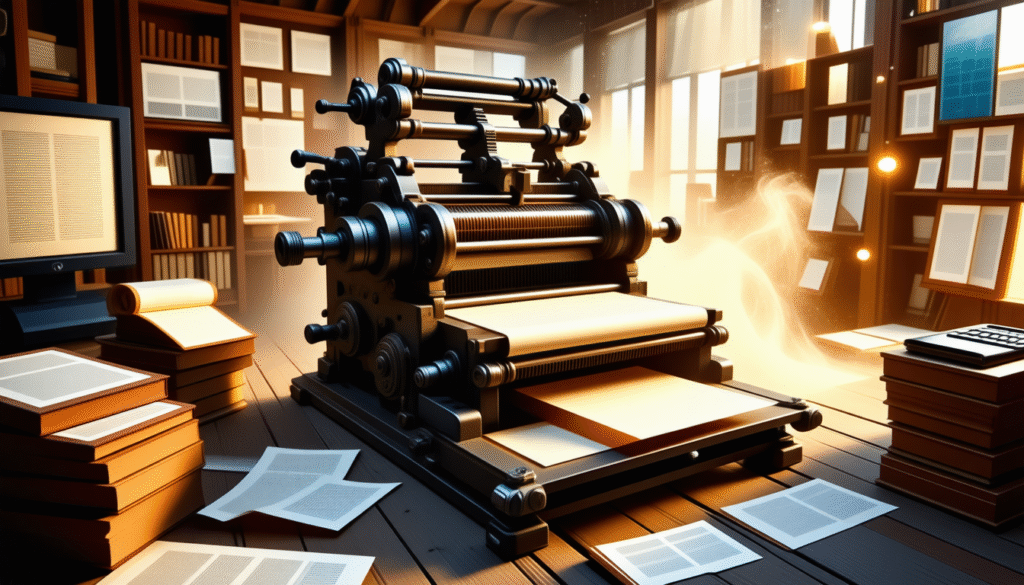
Imagine a world where every single book was painstakingly copied by hand, where sharing even a simple idea required endless hours of transcribing on parchment. This laborious reality prevailed until the dawn of printing technology, which emerged as a monumental game-changer in human communication. Printing technology, encompassing a diverse array of methods used to mass-produce text and images, revolutionized the way societies disseminate knowledge, preserve culture, and foster learning. From ancient China’s pioneering inventions of paper and ink to today’s lightning-fast digital printers, the evolution of printing has shaped civilizations, triggered revolutions, and continues to influence our daily routines in remarkable ways.
The printing revolution goes beyond mere mechanization; it transformed cultures, languages, and social dynamics. It democratized access to information, enabling voices far beyond royal courts and scholarly elites to be heard. This seismic shift laid the groundwork for milestone epochs such as the Renaissance, the scientific revolution, and the spread of democracy. Major companies like HP, Canon, and Epson have carried forward this legacy into the 21st century, creating printing solutions that combine speed, quality, and accessibility. Meanwhile, firms such as Xerox, Brother, and Ricoh support diverse printing needs ranging from corporate environments to creative industries.
Today, printing remains an essential medium despite the ascendancy of digital communication. It harmonizes with new technologies, weaving traditional print with digital integration, creating hybrid experiences that amplify how information is shared and consumed. Whether it’s personalized marketing materials, educational textbooks, or intricate art reproductions by leaders like Konica Minolta and Fujifilm, the evolution of printing underpins a media revolution that is far from over. Let’s dive deep into the intricate journey of printing from its origins to its modern metamorphosis, illustrating how this technology has irreversibly shaped human interaction.
Ancient Origins and the Foundation of Printing Technologies
The story of printing begins far earlier than the celebrated European advent of the printing press attributed to Johannes Gutenberg. Its origins trace back to ancient China, where indispensable innovations including the development of paper around the second century AD charted the course for all subsequent printing breakthroughs.
Picture a civilization grappling with cumbersome and costly writing materials such as bamboo strips and silk scrolls. The invention of paper changed the game by providing an affordable, portable, and versatile surface for writing and printing. This critical breakthrough was paired with the discovery of durable ink formulations and precise engraving techniques, which together created the first practical methods for reproducing texts.
The earliest printing technique was block printing, where artisans carved entire pages of text and images in reverse onto wooden blocks. These blocks then served as stamps, inked and pressed onto paper to create multiple copies. The process sounds tedious—isn’t imagining an entire page carved in mirror writing somewhat mind-boggling?—but it drastically reduced time compared to meticulous hand-copying.
- The Diamond Sutra (868 AD): The earliest known dated printed book, created using woodblock printing in China.
- Religious texts and bureaucratic documents: Among the primary materials reproduced by block printing, facilitating dissemination across vast regions.
- Artistic prints: Woodblock prints also contributed to visual culture by reproducing artistic works on paper and fabric.
The substantial downside of block printing was its inflexibility. Each page required a dedicated carved block, making textual variations or corrections cumbersome. This limitation birthed the innovation of movable type.
In the 11th century, Bi Sheng introduced clay movable type, crafting individual character blocks that could be arranged and reused ad infinitum. This modular approach anticipated the versatile printing systems that would later emerge in Europe. Although had challenges in managing the extensive Chinese character set, movable type set the stage for a print revolution elsewhere.
Korea further advanced this technology by casting metal movable type during the 13th century, enabling durable printing tools and one of the oldest metal-printed texts globally. These East Asian inventions, blending material science with artistry and engineering, created the foundational blueprint for the transformative impact printing would have centuries later in the West.
Gutenberg’s Press and the European Printing Explosion
Fast forward to mid-15th century Europe, an era ripe for technological innovation, where Johannes Gutenberg synthesized prior knowledge into a revolutionary device that accelerated the spread of printed material across the continent. His genius lay not simply in invention but in adapting movable metal type for the Latin alphabet, coupled with refined machinery and oil-based inks.
Gutenberg’s press mechanized and systematized the printing process. Using components including cast metal type, a screw press derived from wine presses, and specially formulated inks, his method dramatically cut production time. His magnum opus — the 42-line Bible — demonstrated the potential to produce books not only swiftly but with beautiful clarity.
What followed was nothing short of a media explosion:
- Book production soared, transforming books from luxury artifacts into widely accessible commodities.
- Literacy rates surged as university courses gained affordable textbooks, while laypersons found printed materials easier and cheaper to acquire.
- Ideas proliferated — the Renaissance, Reformation, and Enlightenment flourished through the rapid dissemination of diverse viewpoints.
Printing’s affordability and reliability allowed a standardized transmission of knowledge. Copies were consistent, minimizing errors typical in manuscript reproduction. This stability fostered language standardization across nations as printed texts circulated widely, influencing spelling and grammar conventions.
Major corporations in printing technology, including Lexmark and Roland, reflect this legacy of ingenuity and precision. Their modern machinery traces conceptual DNA back to Gutenberg’s innovations, continuing the evolution of media dissemination in the digital era.
Printing and the Social Fabric: Education, Politics, and Culture
Printing’s societal impacts go far beyond the mere replication of text; it reconfigured the cultural and intellectual landscape of societies worldwide. One of the clearest revolutions occurred in education. The shift from scarce handwritten manuscripts to mass-produced textbooks democratized learning and altered how knowledge was acquired and shared.
The increase in literacy empowered previously underrepresented groups to access information and engage in public discourse. This change catalyzed scientific advancement by making research and findings more accessible, often shared through printed journals and scholarly publications.
- Scientific Revolution: Printing enabled scientists to publish their discoveries broadly, creating an early form of peer collaboration.
- Religious Reformations: Martin Luther’s theses, mass-produced and widely distributed, sparked massive religious shifts based on printed pamphlets.
- Political Movements: Pamphlets and newspapers were instrumental in fomenting revolutions, such as the American and French Revolutions, by circulating radical ideas.
Moreover, the printing press institutionalized authorship and intellectual property concepts, giving rise to copyright laws. Authority over text stabilized, distinguishing between original works and derivative copies. Public discourse also evolved, with newspapers and periodicals becoming central forums for debate and governance scrutiny, strengthening democratic processes.
Retail printers and manufacturers like Brother, Epson, and HP play an ongoing role today, providing affordable and powerful devices to support education and communication worldwide, enabling local dissemination of print media alongside global publishing giants.
Industrial to Digital: Innovations Reshaping Printing Techniques
The march of industrial progress brought sweeping changes to printing across the 19th and 20th centuries. Mechanization introduced steam-powered presses, revolutionizing speed and volume capabilities and meeting the hunger of expanding newspaper readerships.
Several groundbreaking inventions accelerated production efficiency:
- Rotary Press (1840s): Enabled continuous, high-speed printing on rolled paper, ideal for mass newspapers.
- Linotype and Monotype Machines (1880s): Automated typesetting replaced manual letter arranging, dramatically reducing labor and increasing accuracy.
- Offset Printing: Developed in the 20th century, this method used a rubber blanket to transfer ink, enhancing image quality and enabling economical large runs, especially for magazines and advertisements.
Lithography provided the scientific and artistic basis for modern offset methods, making color printing accessible and widely affordable. This evolution fueled vibrant print cultures, from glossy fashion magazines to detailed art reproductions, enriching consumer experiences and advertising strategies.
In the 1980s, the digital wave surged with the advent of desktop publishing and affordable laser and inkjet printers from companies such as Canon and Ricoh. This era shifted control from industrial printers to individuals and small businesses, heralding an age of print-on-demand, customization, and vibrant small-scale production.
Contemporary digital printers reflect this transformation, combining speed, quality, and environmental sensitivity. Businesses now rely heavily on printing solutions for personalized marketing materials and prototyping, benefiting from the flexibility allowed by digital workflows.
The Persistent Power and Future of Printing Media
In an age dominated by pixels and screens, one might assume printing’s heyday has passed. Yet, printed media endures, thriving alongside digital communication thanks to its tangible and sensory appeal. Readers frequently prefer physical books for in-depth engagement, while printed photographs continue to hold sentimental value in an increasingly virtual world.
Print has also adapted by interacting with digital platforms. Technologies such as QR codes bridge paper and screen, linking printed advertisements, magazines, and packaging to online content. Augmented reality apps respond to printed images, enhancing user interaction and marketing opportunities. Variable data printing allows personalized print products, merging database-driven digital inputs with physical print media.
Leading manufacturers like Fujifilm, Konica Minolta, and Lexmark invest in sustainable inks, innovative substrates, and smart packaging with embedded sensors. The emergence of bioprinting technologies expands printing’s domain into healthcare, offering revolutionary prospects for tissue engineering and prosthetics.
- Eco-friendly inks and materials: Reducing the environmental footprint of printing operations.
- Smart packaging: Incorporation of sensors and interactive elements in printed products.
- 3D printing advances: Layer-by-layer construction of complex objects, merging digital design and physical production.
Printing’s fundamental role remains unchanged: to replicate and disseminate ideas, knowledge, and art. Its ability to evolve with technological advances ensures that this media revolution maintains its critical role well beyond 2025 and into the future.