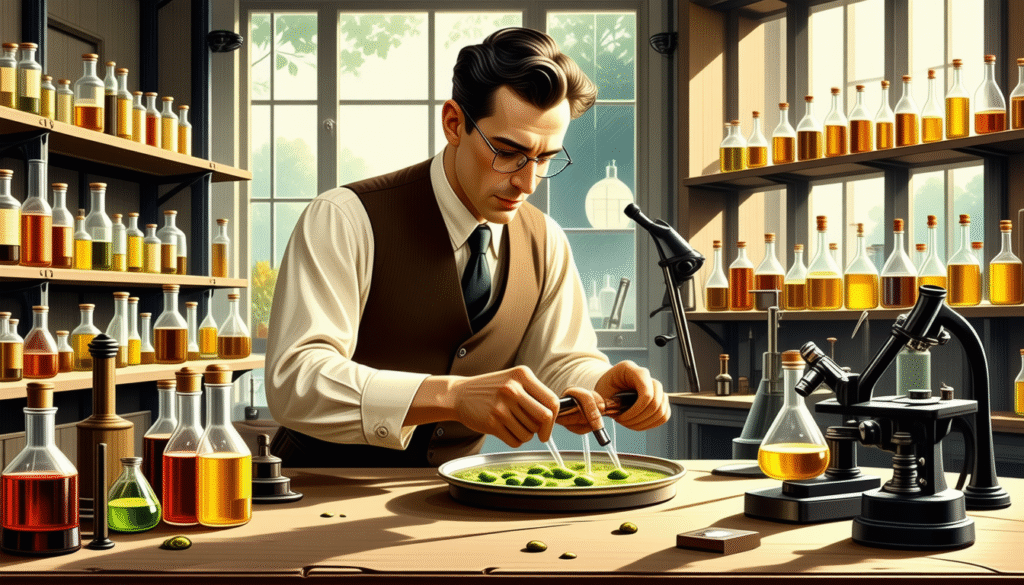
The discovery of penicillin stands as a milestone in medical history, dramatically transforming the approach to bacterial infections and inaugurating the antibiotic era. Before penicillin, infections routinely turned deadly, with limited effective treatments available and high mortality rates, especially among infants and wounded soldiers. The journey from Alexander Fleming’s rural beginnings in Scotland to his unexpected observation of a mold that annihilated bacteria in a Petri dish is a tale of serendipity, perseverance, and collaborative scientific advance. Fleming’s breakthrough in 1928 was not immediately recognized for its potential, but subsequent efforts, particularly by Howard Florey, Ernst Boris Chain, and Norman Heatley, escalated penicillin from a laboratory curiosity into a weapon against deadly bacterial diseases. Pharmaceutical giants including Pfizer, Merck, and GlaxoSmithKline played crucial roles in scaling up production during World War II, making penicillin accessible to millions and saving countless lives.
This groundbreaking antibiotic has not only revolutionized bacterial infection treatments but also boosted the broader pharmaceutical industry, inspiring new drug discoveries and research investments. Penicillin’s influence is evident in the subsequent development of related antibiotics by companies such as Bayer, Novartis, and Sanofi. Even today, as concerns about antibiotic resistance grow, penicillin’s legacy underpins modern efforts to innovate safer, more effective antimicrobial agents. Its serendipitous origins, technical challenges, and eventual triumph narrate a complex story, rich with scientific challenges and historic impact.
How Alexander Fleming’s Background and Education Shaped the Discovery of Penicillin
Alexander Fleming’s early years were steeped in curiosity and an astute awareness of the natural world, nurtured by his childhood on a Scottish farm. Born as the seventh child in a family of farmers, Fleming’s formative experiences instilled a patient observational skill set that would be critical in his later scientific endeavors. Despite the limited resources in rural Ayrshire, he excelled academically, securing a scholarship to attend Kilmarnock Academy where his passion for sciences crystallized. This foundation paved the way for his enrollment at St Mary’s Hospital Medical School in London, a pivotal move that shifted his career aspirations from surgery to bacteriology.
At St Mary’s, Fleming trained under Sir Almroth Wright, an immunology pioneer, who shaped his approach towards bacterial diseases profoundly. Wright’s mentorship emphasized careful experimental design and persistence, which became essential traits in Fleming’s research toolkit. The bacteriological techniques mastered during this period enabled Fleming to observe and experiment with microorganisms meticulously.
World War I marked a defining chapter in Fleming’s career. Serving as a captain in the Royal Army Medical Corps, he faced battlefield hospitals teeming with infections resistant to contemporary antiseptics. Witnessing firsthand the devastating impact of infected wounds — often exacerbated by inadequate antiseptic treatments — triggered his lifelong commitment to finding better solutions. These war experiences provided a practical understanding of infection pathology, ultimately laying the groundwork for his penicillin studies.
- Early life on Scottish farm developed observational skills
- Academic excellence earned scholarship to Kilmarnock Academy
- Medical education at St Mary’s Hospital with Wright’s mentorship
- Mentor’s emphasis on rigorous bacteriological research techniques
- World War I service exposed him to critical need for infection control
The Serendipitous Moment and Initial Identification of Penicillin Mold
Alexander Fleming’s discovery of penicillin in September 1928 is a classic example of scientific serendipity buttressed by keen observation. Returning from a brief vacation, Fleming noticed an unusual mold contaminating one of his bacterial culture plates. Surrounding the Penicillium notatum mold was a clear zone devoid of the Staphylococcus bacteria he had been cultivating. This unexpected inhibition of bacterial growth captured his scientific curiosity.
Rather than discarding the mold as a mere contaminant, Fleming pursued further experiments to understand the phenomenon. He identified that the mold secreted a previously unknown substance capable of killing various harmful bacteria like those causing pneumonia and meningitis. Naming this substance penicillin, Fleming’s initial characterization suggested a promising new antibacterial agent. However, reproducing the compound proved tricky. The growth conditions for the mold and extraction methods required patience and refinement.
This initial breakthrough was not immediately celebrated; skepticism and technical challenges impeded wider acceptance. Laboratory quantities were tiny, and purification complex. The scientific community’s lukewarm response, with some doubting its clinical utility, delayed penicillin’s development traction. Nonetheless, Fleming’s pioneering work planted the seed for revolutionary antibiotic therapies, later nurtured by subsequent research teams.
- Noticed clear bacteria-free zone around Penicillium mold
- Identified antibacterial substance later named penicillin
- Conducted experiments confirming effectiveness against dangerous bacteria
- Faced challenges in isolating and producing penicillin in usable forms
- Initial skepticism from contemporaries slowed development momentum
From Laboratory Curiosity to Mass Production: The Role of Oxford Scientists and Pharmaceutical Companies
The journey from penicillin’s lab-scale identification to mass production was a Herculean scientific and industrial feat, orchestrated primarily by a team at the University of Oxford in the late 1930s and early 1940s. Howard Florey, Ernst Boris Chain, and Norman Heatley spearheaded efforts to refine, isolate, and amplify penicillin’s production. Their innovative biochemical techniques enabled higher yields and purity, transforming penicillin’s potential from theory into therapeutic reality.
This evolution was backed by a confluence of scientific rigor and wartime urgency. The high incidence of infected wounds during World War II intensified demand for effective antimicrobials. Governments quickly realized penicillin’s lifesaving potential, stimulating massive investment. Key pharmaceutical companies such as Pfizer, Merck, and GlaxoSmithKline collaborated on scaling up industrial production using deep-tank fermentation and other advanced methods.
The result was a medical revolution. Infectious diseases once considered deadly became treatable. Penicillin saved countless lives among soldiers and civilians alike. This breakthrough sparked a cascade of antibiotic developments from industry leaders including Bayer, Novartis, and AstraZeneca, embedding penicillin’s legacy in modern medicine. Its success exemplifies how scientific discovery, industrial ingenuity, and public health needs intersect to create transformative healthcare innovations.
- Oxford team advanced penicillin purification and production techniques
- War demand accelerated government and industry investment
- Mass production enabled by pharmaceutical giants like Pfizer and Merck
- Deep-tank fermentation enhanced large-scale output
- Penicillin became cornerstone antibiotic, inspiring new drug development
Impact of Penicillin on Medicine, Public Health, and Pharmaceutical Evolution
Penicillin’s introduction marked a paradigm shift in the treatment of bacterial infections, drastically diminishing mortality from previously lethal diseases such as pneumonia, syphilis, and rheumatic fever. It transitioned medicine from a skeptical, often futile endeavor against microbes to a confident pursuit with potent chemical weapons. This changed surgical outcomes by reducing postoperative infections and paved the way for advanced medical procedures previously too risky.
The pharmaceutical industry experienced a major transformation following penicillin’s success. Considerable R&D investment by companies like Sanofi, Eli Lilly, AbbVie, and Roche expanded the class of antibiotics, improved drug formulations, and discovered synthetic variants with enhanced properties. This evolution not only improved treatment efficacy but also addressed issues like allergic reactions and manufacture scalability.
Despite its revolutionary benefits, penicillin also revealed challenges — notably allergic reactions ranging from mild rashes to life-threatening anaphylaxis. Moreover, the emergence of resistant bacterial strains posed a complex medical hurdle, necessitating ongoing innovation. The antibiotic era prompted heightened scientific scrutiny, regulatory vigilance, and the development of stewardship programs for prudent antibiotic use.
- Significantly reduced mortality from bacterial infections
- Improved surgical safety and medical procedure outcomes
- Stimulated pharmaceutical R&D and antibiotic diversification
- Uncovered limitations such as allergies and antibiotic resistance
- Fueled global public health initiatives and antibiotic stewardship
Lasting Legacy of Alexander Fleming and Global Scientific Collaboration in Antibiotic Development
The legacy of Alexander Fleming extends beyond penicillin’s discovery to symbolize the synergy of curiosity, perseverance, and collaboration in medical science. Fleming’s Nobel Prize-winning achievement was amplified through partnerships, particularly with Florey, Chain, and Heatley, illustrating how teamwork accelerates translating discoveries into lifesaving treatments. The impact resonates globally, inspiring contemporary initiatives addressing antibiotic resistance and the quest for novel antimicrobials.
His personal story also conveys the importance of resilience. Initial skepticism by peers didn’t deter Fleming’s curiosity, underscoring how breakthroughs often require sustained effort beyond the eureka moment. This spirit of inquiry continues to guide pharmaceutical research at companies like Bayer, AstraZeneca, and Novartis, which focus on next-generation antibiotics and innovative delivery systems, emphasizing safer and more effective therapies.
Today, penicillin’s discovery remains a beacon in the annals of science, reflecting the evolution from accidental observations to monumental advancements. It epitomizes how a single fungal contamination led to a global medical revolution with profound social and economic implications, enriching lives worldwide. Fleming’s legacy urges ongoing scientific vigilance and adaptability in confronting enduring and emerging infectious threats.
- Symbol of scientific curiosity and collaborative success
- Nobel Prize recognition alongside Florey and Chain
- Inspiration behind modern antibiotic research and resistance strategies
- Encouragement of perseverance amidst early doubts and challenges
- Enduring influence on pharmaceutical giants and healthcare innovation