The Venice Carnival, or Carnevale di Venezia, stands as a radiant jewel in the realm of global festivities, where history, art, and tradition intertwine to create an enchanting spectacle unlike any other. Each year, this lagoon city transforms into a stage of mystique and glamour, inviting visitors from every corner of the world to immerse themselves in its timeless masquerade. Far beyond mere celebration, the Carnival embodies a rich tapestry of cultural legacy and theatrical elegance, where Venetian Masks reign supreme as emblems of both anonymity and artistry. As the city’s canals glisten under the soft glow of masked revelers’ footsteps, the air fills with an aura of Lagoon Elegance, enchanting both locals and tourists.
Tracing its roots back to the Middle Ages and flourishing through the Renaissance and Baroque periods, the Venice Carnival holds a remarkable place in history as a festival that transcended social hierarchies and delved into the human penchant for disguise and revelry. The blend of Carnival Couture, intricate costumes, and symbolic masks creates a vibrant tableau that blurs the line between reality and fantasy. The Golden Gondola glides quietly among the streets, offering a backdrop where past and present merge seamlessly. Its enduring popularity, drawing up to 3 million visitors annually, attests to the festival’s unparalleled ability to preserve cultural heritage while pulsating with modern-day excitement. As one witnesses the Mystic Masquerade unfold in Piazzo San Marco and beyond, the spirit of Classic Venezia unfurls before the eyes like a living painting.
Venetian Masks: Crafting the Soul of an Eternal Festival
No element stands more iconic in the Venice Carnival than the revered Venetian Masks. More than mere disguises, these masks symbolize a powerful social tool that historically granted wearers freedom from the rigid Venetian class system. Traditionally worn between December 26 and Shrove Tuesday, masks allowed people to mingle anonymously, indulging in pleasures and liberties not often permitted in daily life. The mask’s freedom facilitated a unique social experiment where roles were inverted and hierarchies temporarily abolished.
Venetian Masks come in diverse styles, each representing distinct social and theatrical characters. The Bauta, for example, is a full-face covering with a protruding chin and no mouth, allowing worn anonymity while permitting speech and consumption of food and drink. Traditionally worn with a tricorn hat and cape, the Bauta became a fixture in political gatherings, enabling honest voting without fear of repercussion. The Colombina is a half-mask reflecting the famous soubrette of the commedia dell’arte, lavishly decorated with jewels and feathers, offering elegance while showcasing expressive eyes. Another unforgettable type is the Medico della Peste, a stark white mask with a long beak originally designed to protect plague doctors but now adopted as a symbolic memento mori at the Carnival.
The craftsmanship behind these masks is an art form preserved through centuries. Mask makers, or mascherari, were once esteemed members of society with their own statutes. Modern production melds centuries-old techniques—such as using gesso, gold leaf, and delicate hand-painting—with contemporary artistry to produce Carnival Couture that dazzles attendants worldwide. With breathtaking designs ranging from the minimalistic to the ornately lavish, these masks encapsulate the Carnival Legacy, representing not only spectacle but also profound cultural significance.
- Mask styles such as Bauta, Colombina, Medico della Peste, Moretta, and Volto illustrate the festival’s diversity.
- Production combines traditional materials like porcelain and leather with gold leaf, gems, and feathers.
- The mask-wearing tradition allowed suspension of social rules, enabling a playful inversion of societal roles.
- Annual competitions like “la maschera più bella” showcase innovations and celebrate the finest designs.
- The masks preserve artistry unique to Venice, resisting the mass-market, low-quality imitations.
Carnival Couture: The Art of Splendor in Classic Venezia
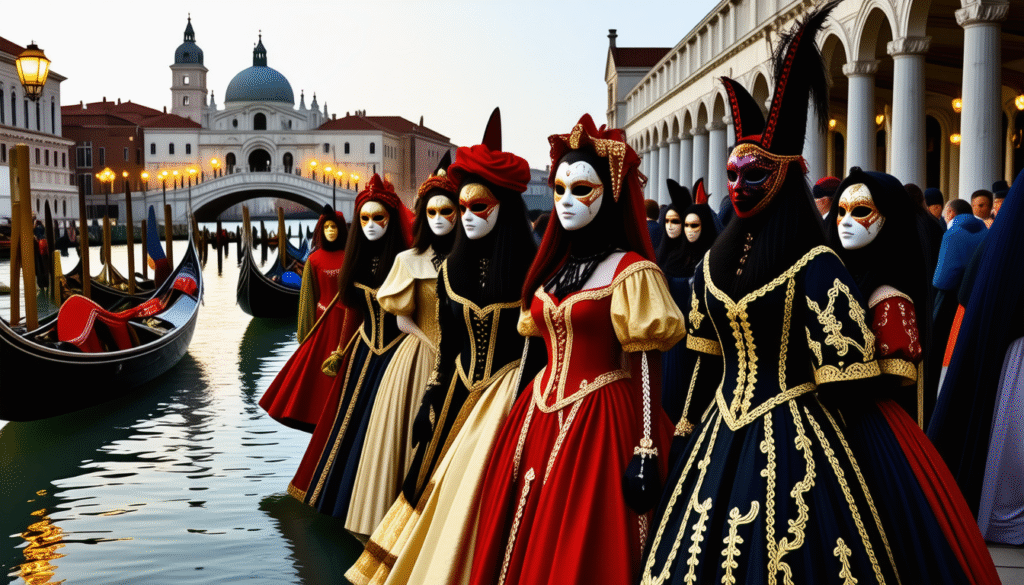
The Venice Carnival transcends masks alone; its essence is emphatically woven into the lavish costumes that evoke the grandeur of a bygone era. Costumes at this timeless masquerade elevate the visual splendor and immerse participants in a theatrical experience. Inspired by periods ranging from Renaissance elegance to Baroque opulence, the Carnival Couture manifests through lavish silk robes, embroidered velvet cloaks, intricate laces, and sparkling gemstones. This sartorial extravaganza invites attendees to embody the aristocratic vibe of the Serenissima Republic while promenading through labyrinthine alleys and canals lined with glowing lampposts.
Among the most notable features are the stunning gowns worn by participants, often paired with accessories such as chokers, gloves, and delicate fans. Attention to detail is paramount; dazzling headdresses adorned with peacock feathers or shimmering jewels complete the look, emphasizing the wearer’s transformation into a living artwork. These costumes do not merely serve decorative purposes but also narrate stories from Venice’s rich past. For instance, the use of certain motifs—such as lions (a nod to Venice’s patron saint, St. Mark)—conveys symbolic pride and historical continuity.
Participating in the Venice Carnival means joining a centuries-old tradition where sartorial choices contribute to the overall atmosphere of Lagoon Elegance. Contemporary designers often blend traditional aesthetics with modern twists, creating costumes that surprise and inspire. The profound effort invested in every fabric fold and ornament reflects the spirit of Venice itself—ornate, mysterious, and eternal.
- Costumes showcase historical references from Renaissance, Baroque, and Venetian nobility dress codes.
- Frequent use of rich materials like velvet, silk, lace, gold embroidery, and jewels.
- Accessories such as fans, gloves, and headdresses augment the regal appearance.
- Modern designers innovate within the framework of traditional motifs.
- Costume balls and parades serve as grand showcases for Carnival Couture.
Timeless Masquerade: The Historical and Social Tapestry of Venice Carnival
The Venice Carnival’s timeless allure extends beyond visual aesthetics; it plays a substantial cultural and social role rooted in centuries of Venetian life. Originating in the 12th century following a victorious military campaign, the Carnival evolved into a sanctioned period of festivity where societal norms loosened, and anonymity allowed unfettered revelry. Over time, it became an official Renaissance extravaganza, drawing aristocrats and commoners alike into a realm of masked intrigue and joyful transgression.
This festival historically facilitated satire, escapism, and a mask-wearing liberation from Venice’s notorious class distinctions. During the Baroque era, the Carnival attained a prestigious global reputation, reinforcing Venice’s image as a cultural beacon. However, by 1797, under Emperor Francis II, the Carnival and mask usage were banned as part of efforts to restore order. This hiatus lasted until a revival in 1979, when the Italian government recognized the event’s cultural and economic significance, spurring its return as a modern spectacle attracting millions.
Today’s Carnival maintains its legacy through components such as costume balls, theatrical performances, and parades that recall the extravagances of old with a contemporary twist. Events like the “Flight of the Angel” herald the festival’s commencement with breathtaking precision, blending history with modern entertainment. The masking tradition thus persists as a metaphor for human duality—the interplay between appearance and reality, freedom and constraint.
- The origin links to a 12th-century Venetian military victory and subsequent public celebration.
- The Renaissance period ushered in the Carnival’s official status, expanding cultural influence.
- The 18th century Baroque Carnival epitomized Venice’s global grandeur and social license.
- Banning in 1797 interrupted the tradition until its official modern revival in 1979.
- Modern celebrations include theatrical performances, costume contests, and grand balls.
Lagoon Elegance: Exploring Venetian Traditions and Events During Carnival
The Venice Carnival is a feast of traditions that breathe life into the city’s unique embrace with the surrounding lagoon. Anchored in customs that reach back centuries, it offers a blend of public spectacles and intimate gatherings where artistry and culture flourish. One of the pillars of the Carnival experience is the parade of gondolas decorated in the most exquisite fashion, often called the Golden Gondola procession. These slow, hypnotic journeys along Venice’s waterways exemplify the serene beauty intertwined with the festival’s vibrant energy.
Another cornerstone of the Carnival rhythm involves the masked balls—lavish affairs set in historic palazzos and opulent venues, where attendees don their finest Carnival Couture and dance under chandeliers dripping with crystals. These evenings echo the social rites of Venetian nobility, combining music, dance, and mystery. Street performances and artisan markets complement the grand occasions, providing accessible moments for visitors to partake in the Carnival’s creative pulse.
In recent years, the Venice Carnival has embraced modern technological enhancements without losing its essential spirit. Digital projections illuminate façades, while traditional fireworks displays illuminate the night sky, fusing novel spectacle and timeless charm. Visitors interested in mask-making workshops can engage directly with the craftsmanship, fostering an appreciation for this delicate Venetian trade. This interactive cultural exchange sustains the festival’s vibrancy and passes its traditions to future generations.
- Golden Gondola parades highlight Venice’s iconic waterways adorned with lavish decorations.
- Masked balls held in historic venues offer immersive, formal social experiences.
- Street performers, artisan markets, and workshops provide interactive cultural participation.
- Technological enhancements such as light projections and fireworks entertain diverse audiences.
- Mask-making classes allow visitors to connect personally with Venetian artistry.
Carnival Legacy: The Enduring Influence and Modern Celebrations of the Venice Carnival
The Venice Carnival’s allure thrives in its capacity to adapt while preserving its ancient customs, making it a beacon of Eternal Venice. This festival, with an annual attendance approaching three million, showcases a dynamic fusion of history and modernity. The evolution from its medieval origins through periods of prohibition and revival underscores its resilience and significance. Present-day Carnival festivities honor this lineage with a blend of innovation and fidelity to tradition.
A significant highlight is the international competition for la maschera più bella—awarded to the most beautiful mask—which spotlights masterful craftsmanship and imaginative design. Winners such as the 2023 champion’s Astrostar and remarkable themed costumes showcase the continuous creativity fueling the festival. Moreover, the Carnival’s impact resonates culturally beyond Venice, influencing film, literature, and fashion worldwide, with iconic Venetian Masks making cameo appearances in works from cinematic masterpieces to popular video games.
The Venice Carnival also symbolizes a deeper reflection on identity and disguise in society. The tradition invites both locals and tourists to engage with the mystique of anonymity, fostering a spirit of playful exploration. In a world increasingly dominated by digital interaction, the festival reminds us of the irreplaceable charm of physical presence and human craftsmanship. As the celebrations unfold, the Serenissima Classics come alive, reminding all who attend that the Venice Carnival is more than just an event—it is a vivid narrative spanning centuries that continues to evolve while remaining deeply rooted in its core essence.
- Annual attendance nears 3 million, reflecting global fascination with the event.
- The maschera più bella competition highlights ongoing mask-making innovation.
- Venetian Masks influence arts and culture well beyond Italy’s borders.
- The festival balances tradition with modern presentations and technology.
- Cultural reflection on anonymity and identity resonates especially in today’s society.