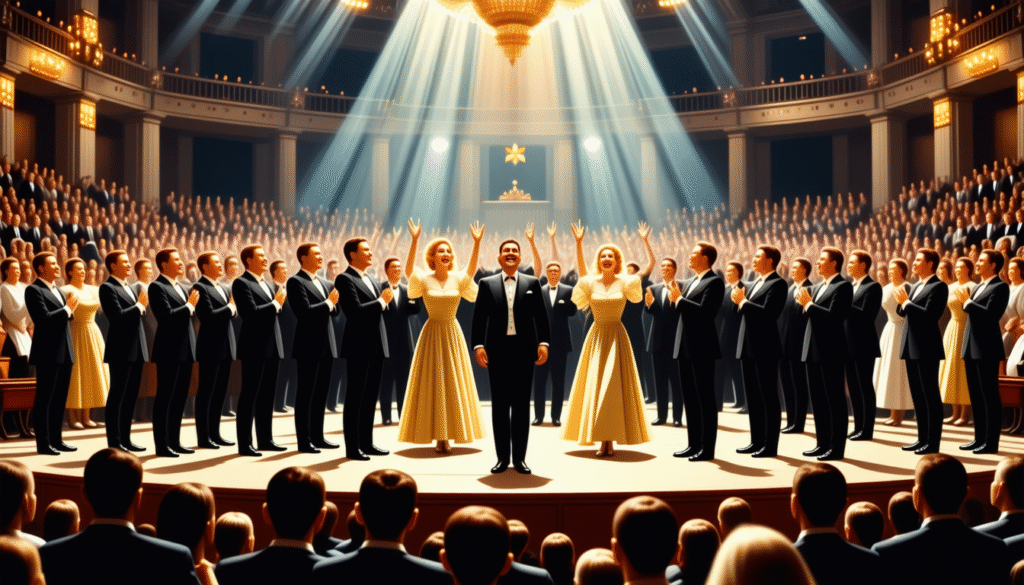
The Eurovision Song Contest, now a dazzling spectacle of music and culture, owes its rich legacy to a modest event held on the 24th of May, 1956. Conceived as a unifying broadcast endeavor by the European Broadcasting Union (EBU), its inaugural edition took place at the Teatro Kursaal in Lugano, Switzerland. This embryonic iteration of Eurovision was inspired by the successful Sanremo Music Festival in Italy, aiming to stitch together a continent healing from wartime scars through a shared artistic celebration. The evening was succinct yet potent, with countries sending two songs each, a format quickly abandoned in later editions. Switzerland’s own Lys Assia emerged victorious, propelling her song “Refrain” to historic prominence as the contest’s first winning entry. This moment not only marked Switzerland’s cultural achievement but also inaugurated a tradition that would captivate millions across generations.
Beyond being a mere competition, the first Eurovision Song Contest seeded a cultural ritual transcending language barriers and national borders. The event represented a unique platform where European nations could engage in friendly rivalry, not with weapons, but through melody and lyricism. This notion of unity through art continues to resonate in the grand finals of subsequent contests, shaping Europe’s entertainment tapestry. Although the scoreboard of the first contest was limited to announcing only the winner without detailed point counting, it set the stage for evolving voting mechanisms that today are an integral part of Eurovision’s thrilling suspense.
Switzerland’s Pioneering Triumph in the 1956 Eurovision Song Contest
Switzerland’s role as the host and champion of the maiden Eurovision Song Contest cemented its place in the annals of European music history. The venue, Teatro Kursaal in Lugano, not only provided the physical space but also symbolized the heart of a budding transcontinental entertainment event. Lys Assia’s rendition of “Refrain” was characterized by its elegant simplicity and emotive delivery, capturing the hearts of judges across participating countries. The voting system then operated differently compared to modern times; it involved juries giving two votes per country without announcing detailed points or runner-ups. This secrecy in scoring elevated the suspense but also limited public discussion about the contest’s competitive aspect.
Key factors contributing to Switzerland’s win included the nation’s musical heritage and Assia’s charisma. Known for her clear voice and stage presence, Assia personified the contest’s aims: fostering European closeness via cultural exchange. Her victory underscored the importance of song quality and heartfelt performance over spectacle—a principle later to be reshaped as Eurovision grew into a glitzy multimedia event.
- Lugano’s Teatro Kursaal: Host venue setting the tone of sophistication.
- Lys Assia’s “Refrain”: An emblem of melodic purity and emotional resonance.
- Unique Voting System: Early jury-only votes without public point tallies.
- Swiss Cultural Influence: A nurturing ground for musical talent.
- European Broadcasting Union’s Role: Visionaries linking diverse nations through a shared broadcast.
This pioneering victory by Switzerland paved the way for a contest that today includes over forty countries, showcasing various music genres and reflecting an ever-diversifying European cultural landscape.
The Evolution of Eurovision’s Voting System and Its Impact on the Competition
Initially, the Eurovision Song Contest relied on a straightforward voting approach, wherein juries from each participating country had the liberty to distribute two votes, with only the winner being identified publicly. Over subsequent decades, the framework evolved to accommodate the increasing number of participants and the complexities of public engagement.
Modern Eurovision combines jury assessments with televoting, an intricate dance balancing expert opinion and popular sentiment. The goal is a fair representation of artistic merit and audience appeal. This amalgamation has occasionally led to surprising discrepancies between jury preferences and the public vote, adding layers of unpredictability. For instance, in some recent contests, the jury’s top choice differed markedly from the televoter’s favorite, stirring debates among fans and experts alike.
The gradual transition from a modest voting method to today’s technologically advanced, transparent system reflects broader democratic trends and media interaction in Europe over the past seventy years. Nowadays, points are awarded in a detailed 12-point system, contributing to the spectacle’s climax during the Grand Final. This method has maintained audience excitement and reinforced Eurovision’s cultural relevance.
- 1956 Starter Format: Juries with two votes per country, winner-only announcement.
- Introduction of Public Televoting: Increasing viewer participation since the late 1990s.
- Jury and Televote Combination: Balanced outcomes aiming at fairness and diversity.
- Voting Controversies and Debates: Turning points shaping public trust and contest reforms.
- Points Presentation: Iconic 12-point scale creating tension and drama in modern Grand Finals.
These developments illustrate how Eurovision adapts in tandem with technological advancements and cultural expectations, ensuring its continued status as a beloved event.
Legendary Winners Who Shaped Eurovision’s Prestige and Popular Culture
While Lys Assia opened the Eurovision chronicle with “Refrain,” the contest has birthed numerous iconic winners whose careers transcended the competition. Swedish group ABBA’s 1974 victory with “Waterloo” exemplifies this leap, turning them into global superstars far beyond the contest’s confines. Similarly, Canadian-born Céline Dion’s 1988 win for Switzerland with “Ne partez pas sans moi” marked a pivotal moment, launching her into an illustrious international music career.
These victories underscore Eurovision’s power to spotlight talent that resonates across continents and generations. More recently, winners like Duncan Laurence (2019, The Netherlands) and Måneskin (2021, Italy) have enjoyed worldwide acclaim, propelled by streaming platforms and an evolving digital music landscape. Their successes illustrate Eurovision’s ongoing ability to serve both as a career springboard and a cultural touchstone.
- ABBA (1974): Sweden’s triumph that became a global pop phenomenon.
- Céline Dion (1988): A halftime win that propelled international stardom.
- Duncan Laurence (2019): Modern sleeper hit success through “Arcade.”
- Måneskin (2021): Revitalizing rock and expanding Eurovision’s genre diversity.
- Legacy of Eurovision Winners: Artists who blend Eurovision renown with lasting global impact.
These figures illustrate a fascinating spectrum where Eurovision bridges the worlds of television entertainment and mainstream music industries, creating stories of breakthrough and perseverance.
How Eurovision Fostered a Pan-European Cultural Identity Through Music
From its inception, Eurovision was conceived not simply as a contest but as a cultural initiative fostering European unity. In the aftermath of World War II, the participating nations of the 1950s sought common ground and a new shared identity. The European Broadcasting Union’s pioneering idea of a music contest on television offered a medium that transcended borders, languages, and political rifts.
Eurovision’s unique format encouraged countries to present songs reflective of their cultural heritage, languages, and musical trends, enriching the collective European mosaic. The event became an annual rendezvous connecting millions, promoting mutual understanding through art. It also initiated a tradition where nations competed in a friendly, non-political manner, shifting focus from conflict to creativity.
- Post-war Unity Effort: Eurovision as a tool for healing and cultural exchange.
- Language and Tradition: Showcasing diverse tongues and styles on a continental stage.
- Annual Gathering: Creating a shared ritual for broadcasters and audiences alike.
- Artistic Diplomacy: Replacing rivalry with celebratory competition.
- Lasting Cultural Influence: Eurovision’s role in shaping European awareness and pride.
By providing a unifying platform, Eurovision does more than entertain—it cultivates a sense of belonging and common heritage among disparate nations, a tradition still potent in 2025.
The Unforgettable Moments and Records Set Since Eurovision’s First Victory
Since Lys Assia’s historic win, Eurovision has witnessed countless remarkable moments and record-breaking feats. Over nearly seven decades, the contest has expanded from seven countries to more than forty participants representing a mosaic of cultures. This evolution brought with it extraordinary performances and unprecedented accomplishments.
Among notable records, Ireland and Sweden share the highest number of victories, each with seven wins. Johnny Logan, dubbed “Mr. Eurovision,” boasts three wins across performing and songwriting roles, while Sweden’s Loreen remains the only artist to win Eurovision twice as a performer in the 21st century. The contest has also seen unique results such as the four-way tie in 1969, a never-repeated phenomenon adding to the contest’s lore.
Eurovision’s trophy, crafted in delicate glass resembling a 1950s microphone, has become iconic—though famously fragile. Winners like Alexander Rybak (2009), Nemo (2024), and JJ (2025) have all experienced the amusing mishap of their trophies breaking shortly after receiving them, a quirky trademark adding charm to the contest’s legacy.
- Ireland and Sweden: Holding the record for most wins with seven each.
- Johnny Logan: Unique triple winner and prolific songwriter.
- 1969 Four-way Tie: An unprecedented shared victory among four nations.
- Trophy Traditions: An elegant but fragile symbol inspiring memorable moments.
- Continuous Growth: From seven to over forty competing countries over the decades.
These enduring milestones reflect the contest’s rich and evolving history, underscoring its cultural significance across Europe and beyond.