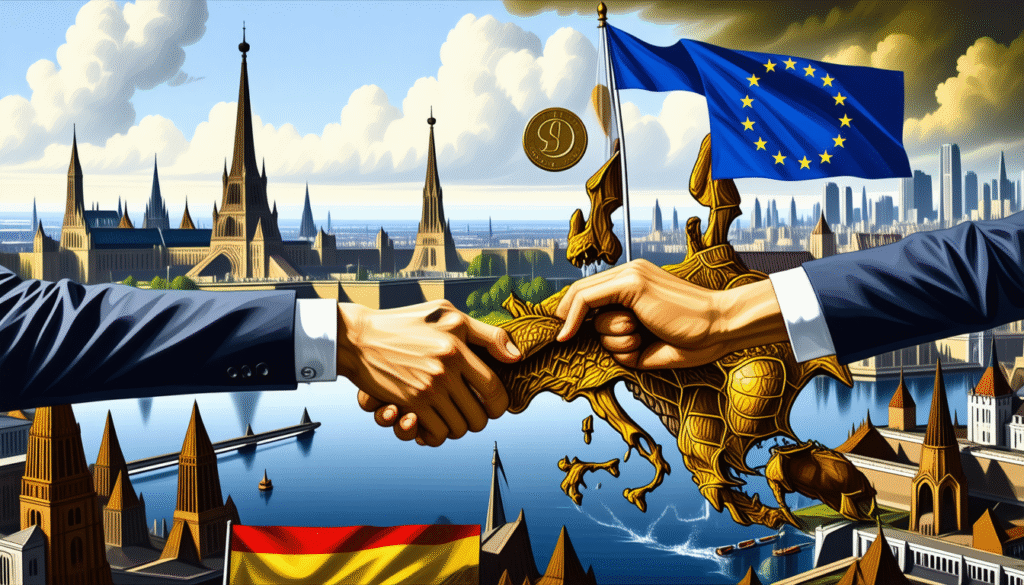
In the aftermath of the devastating World Wars, Europe found itself fractured not just physically but politically and socially. A continent riddled with conflict, distrust, and dire economic conditions, it was clear to many visionaries of the mid-20th century that only unprecedented cooperation could prevent further destruction. This necessity planted the seeds for what would evolve into the European Union (EU), a unique political and economic coalition. The origins of this union are steeped in a mix of savvy diplomacy, ambitious treaties, and a good dose of historical irony, given the centuries of rivalry among member nations. The journey from scattered nation-states, each fiercely independent, to a bloc united under common institutions is a saga that blends pragmatism with idealism—highlighted by key milestones such as the Schuman Declaration, the Treaty of Paris, and the Treaty of Rome.
Despite ongoing challenges and debates over sovereignty and economic policy, the EU today stands as one of the world’s most remarkable experiments in multinational governance. Exploring the origins of the European Union unveils a fascinating story of resilience, compromise, and unity—revealing how formerly warring countries discovered strength in partnership and shared goals.
How the Post-War Context Sparked the European Economic Community
At the core of the EU’s creation lies the stark reality of post-World War II Europe: an urgent need for peace and recovery drove countries toward unprecedented collaboration. The war’s destruction had obliterated infrastructure, economies were in tatters, and national animosities ran deep. It was during this turbulent period that the Schuman Declaration emerged in 1950, articulated by French foreign minister Robert Schuman. His proposal was both clever and strategic: fuse the coal and steel industries of France and Germany to make war materially impossible. This was ingenious because these industries were the backbone of military power, so any conflict between these countries would be economically and logistically unfeasible.
This seminal declaration led to the Treaty of Paris in 1951, establishing the ECSC (European Coal and Steel Community). It was the first supranational institution, involving France, Germany, Italy, Belgium, the Netherlands, and Luxembourg. The ECSC wasn’t merely about industry; it was a political statement amid lingering hostilities, striving to forge trust through economic interdependence.
Within this framework, the ECSC created vital precedents:
- Supranational decision-making: Member countries relinquished some sovereignty to a higher authority to oversee coal and steel production.
- Joint economic management: Shared control over sectors vital for defense, reducing unilateral national control.
- Peacekeeping through economy: Economic integration served as a bulwark against conflicts by aligning national interests.
These measures laid the foundation for further integration, demonstrating how economic collaboration could double as diplomatic glue. Countries that once faced each other across battlefields were now colleagues in a shared venture.
The Treaty of Rome and the Dawn of the European Economic Community
The early success of the ECSC inspired broader ambitions. In 1957, six domestic powers—those involved in the ECSC—signed the Treaty of Rome, which created the European Economic Community (EEC). This marked a significant leap beyond managing coal and steel: the EEC aimed for a common market embracing goods, services, labor, and capital. It was an economic vision designed to fuel prosperity while weaving countries closer on multiple fronts.
This treaty not only institutionalized the common market but also introduced:
- Customs union: Tariffs were eliminated between member nations, enhancing trade efficiency.
- Regulatory alignment: Standards, competition policies, and shared agricultural programs began harmonizing national laws.
- Expansion of cooperation: Beyond economics, the treaty laid groundwork for political integration through emerging institutions like the European Parliament.
The Treaty of Rome’s impact extended beyond economic policies. It charted the course for future enlargement and cooperation within Europe and played a key role in developing Euratom, the nuclear energy community, which further diversified collective undertakings.
Interestingly, initial attempts to join the community, such as those by the United Kingdom in the 1960s, were blocked by General Charles de Gaulle and France, citing economic and political concerns. These episodes illustrate the complex interplay of national interests amid integration efforts. However, by 1973, the UK, Ireland, and Denmark joined the club, signaling a growing acceptance of the EEC vision.
This expansion set the stage for the Single European Act of 1986, which aimed to complete the internal market by removing remaining physical, technical, and fiscal barriers, thus intensifying economic interdependence and paving the way for the eventual formation of the European Union.
The Maastricht Treaty: Birth of the European Union and New Horizons
Arguably, the most defining moment in the EU’s history came in 1992 with the signing of the Maastricht Treaty. This treaty transformed the European Economic Community into the European Union, a much broader entity encompassing not only economic but also political, social, and security aspects. The treaty introduced innovative features such as European citizenship—allowing citizens to live, work, and vote across member states—and the plan for a single currency, the Euro.
The Maastricht Treaty set out three pillars which structured the Union:
- The European Communities: Economic integration mechanisms evolved into the backbone of the Union.
- Common Foreign and Security Policy: A framework for joint diplomatic and defense initiatives.
- Cooperation in Justice and Home Affairs: Harmonization efforts in policing, immigration, and asylum policies.
This treaty also streamlined the institutional architecture, increasing powers of the European Parliament and formalizing the roles of bodies like the European Commission and the European Council, facilitating a hybrid governance model that balanced national sovereignty with supra-national coordination.
As a case study, the introduction of the Euro exemplifies the complexities and opportunities of integration. While 19 of 27 member states adopted the new currency, others like the UK and Denmark secured opt-outs, highlighting the persistent tensions between collective ambitions and national preferences.
The Maastricht Treaty’s ratification was met with hesitation and political debate in many countries but ultimately demonstrated a shared commitment toward creating a unified Europe, capable of facing global challenges collectively and efficiently.
Key Institutions and Their Roles in Forging Integration
Understanding the origins of the European Union requires appreciating how its main institutions underpin decision-making and governance. Since the early days of the ECSC, institutional innovation has been at the heart of European integration, evolving in response to increasing membership and policy scope.
Here are some pivotal entities and their functions:
- European Commission: The executive branch, responsible for proposing legislation, implementing decisions, and managing day-to-day affairs.
- European Parliament: The directly elected body representing EU citizens, sharing legislative powers and oversight responsibilities.
- Council of the European Union: Represents member state governments, coordinating policies and approving laws.
- European Council: Comprises heads of state or government, setting the EU’s overall political direction.
- Court of Justice of the European Union: Ensures compliance with EU law and resolves disputes among members.
- European Central Bank: Manages monetary policy for eurozone countries, safeguarding currency stability.
Each institution contributes a unique piece to the complex mosaic of European governance, embodying a precise balance between supranational ambitions and intergovernmental respect. The interplay of these bodies has allowed the EU not only to survive but to thrive despite crises like the 2008 financial crash, migration influxes, and Brexit.
This institutional framework is crucial in understanding why the EU remains a singular model of regional cooperation in the world, merging democratic legitimacy and effective policymaking.
Challenges and Expansion: The Road Beyond Origins
From its modest beginnings with six founder states, the EU has grown to encompass 27 countries. However, its evolution has never been a smooth ride. Expansion has brought diverse cultures, languages, and political interests under one roof, while challenges like Brexit and financial turmoil test its resilience.
Here’s a snapshot of ongoing dynamics shaping the EU in 2025:
- Membership growth: Countries like Croatia (joined in 2013) illustrate ongoing European attraction, while others express ambitions to join pending economic and political reforms.
- Brexit impact: The United Kingdom’s departure posed questions on budget contributions, trade frameworks, and political balance, reshaping EU strategies.
- Borderless travel: Thanks to the Schengen Agreement initiated by a handful of countries in 1985, 26 nations abolished passport controls internally, although border security remains a complex issue amid migration pressures.
- Financial frameworks: Tools such as the Multiannual Financial Framework (MFF) set budgetary priorities and help manage shared spending effectively.
- Policy diversification: Agriculture, fisheries, digital transformation, climate ambitions, and education programs like Erasmus+ continue to exemplify the EU’s multifaceted reach.
The union has also adopted the Charter of Fundamental Rights to protect human rights and launched policies under the Common Foreign and Security Policy to coordinate international diplomacy. Although not possessing its own standing army, the Common Security and Defence Policy enables peacekeeping and crisis management missions worldwide.
Thus, the story of the European Union continues to evolve. While rooted firmly in its origins—embodied by agreements like the Schuman Declaration and the Treaty of Rome—it faces 21st-century tests that will shape its future trajectory.