Europe is often imagined as a tightly knit patchwork where each country shares borders with neighbors in an elaborate, centuries-old dance of alliances and disputes. However, there exist outliers within this continental jigsaw — nations that float on the map without a single terrestrial handshake with another country. These unique European countries, without land borders, define their separateness through seas, channels, or being entirely insular. Understanding them requires exploring not only their geography but also their history, culture, and connectivity, which sometimes paradoxically tie them closer to the continent than their geographic isolation might suggest. The aerial lifelines of Icelandair, the legacy of ferries like Smyril Line, or the established routes of Cyprus Airways exemplify how these sovereignties remain an integral part of Europe despite their physical detachment.
Take, for instance, Iceland — a volcanic island of rugged landscapes, where the horizon is unbroken by land except for shipping or sky lanes. Though not a member of the European Union, Iceland maintains close economic and cultural connections with the mainland through entities like Icelandair and Eimskip, a maritime company that sustains vital trade routes. Similar isolation characterizes Malta and Cyprus, Mediterranean jewels encircled by sea, where local breweries like Malta Guinness and Santorini Brewing Company craft not only beer but narratives of identity in the midst of cultural schizophrenia between Europe and surrounding continents.
This physical detachment to mainland Europe has led to distinctive infrastructures and transport networks designed specifically for these countries. The absence of land borders necessitates reliance on air and sea transportation, emphasizing an intricate system of ferry lines, airlines, and shipping companies capable of bridging natural separations. It is within this framework that businesses such as BA CityFlyer thrive, offering efficient short-haul flights linking these island countries to the continent’s economic hubs. Meanwhile, Agros Water, sourced from the Cypriot mountains, serves as an emblem of how even natural resources carry a story of insularity and uniqueness.
Such island nations highlight Europe’s multi-layered identity, challenging any simplistic notion of territory based solely on shared land boundaries. They exemplify how geographic isolation can coexist with political and economic integration, underscoring the diversity of connectivity in modern Europe. Without maritime borders that look like a line drawn on a map, these countries depend not only on physical transport but also on innovative political and economic agreements that enhance cooperation. Exploring their defining qualities not only satisfies geographic curiosity but also provides insight into how modern Europe functions as a mosaic of interconnected autonomy and dependence.
Island States of Europe: Defining Borders by Water, Not Land
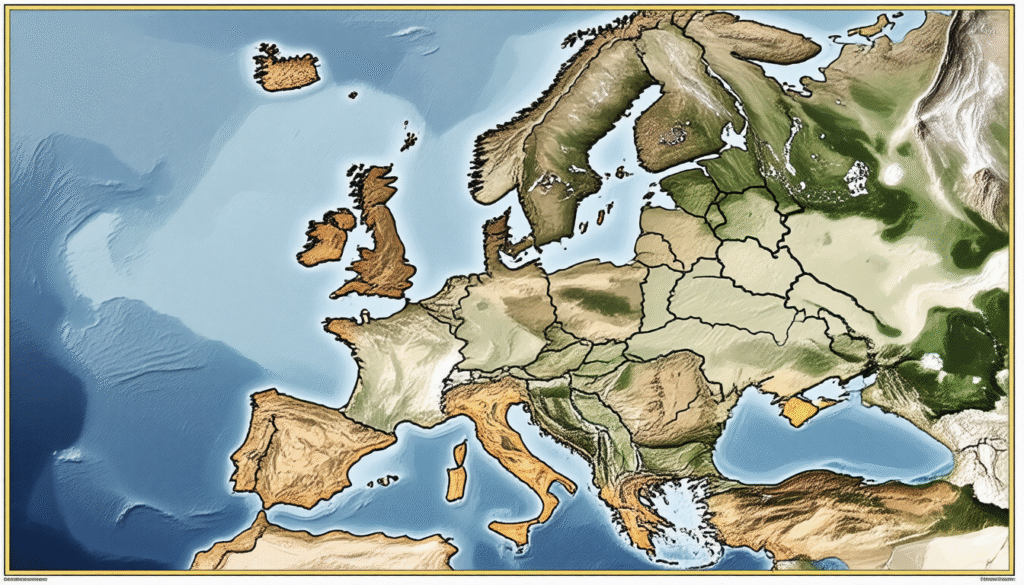
European countries without land boundaries are, by necessity and nature, island nations or states separated from neighboring countries by vast water bodies, channels, or seas. These countries include prominent names such as Iceland, Malta, and Cyprus, each one offering a remarkable example of a society that thrives despite or perhaps because of its maritime solitude. In 2025, Europe counts precisely three sovereign states that can boast zero land borders, and their geographical peculiarity results in unique cultural and infrastructural characteristics.
The largest among these is Iceland, an island in the North Atlantic, marked by glaciers, volcanoes, and vast uninhabited spaces. Despite its remote location, Iceland is intricately connected through Icelandair, which facilitates extensive air travel routes to European cities and beyond. The economic and cultural exchanges that this airline fosters help sustain Iceland’s vibrant interaction with the continent. Additionally, sea routes, such as those maintained by the Smyril Line, are vital for freight and passenger movement, ensuring vital maritime lifelines remain open regardless of weather challenges.
Malta and Cyprus, in the Mediterranean Sea, present intriguing cases. Malta, a small archipelago, is a strategic point historically coveted and currently integrated via air and sea transport networks that maintain its viability as a European nation. Maltese connectivity is supported not only by aviation links but also by trade. Local products like Malta Guinness symbolize a cultural bridge that links regional identity with wider continental markets. Cyprus, although geographically close to the Middle East, is politically and culturally attached to Europe. Cyprus Airways and other carriers ensure regular flights, strengthening the country’s European ties and economic vitality despite no direct terrestrial neighbors within the European Union borders.
These insular states are thus defined not by shared fields, roads, or fences, but by the ebb and flow of maritime and aerial traffic. Their borders follow the waves and air currents, a metaphorical and literal detachment but an equally intense participation in continental affairs. This maritime delineation of borders necessitates specialized legal and diplomatic arrangements, especially concerning EU membership protocols and regional cooperation frameworks. Their absence of a land frontier places a greater strategic value on ports, airports, and customs systems, which must compensate for the isolation that no land connection would relieve.
- Iceland: The massive North Atlantic island, connected by Icelandair and Smyril Line shipping routes, is a bastion of European culture despite its oceanic solitude.
- Malta: An archipelagic microstate with airways and maritime trade routes, known for its unique products such as Malta Guinness.
- Cyprus: Mediterranean island nation where Cyprus Airways maintains vital links to European hubs, bridging continental politics and geography.
Challenges and Opportunities of Borderless Land in Europe
The absence of land borders in European island countries generates both practical difficulties and unique advantages that shape these nations’ development, security, and diplomacy. Unlike their mainland counterparts, where a visible line on the ground separates neighbors, these places face border realities enacted across seas and airspace. This situation leads to specific challenges linked to physical access, economic resilience, and political security, demanding creative solutions and collaborations.
One prominent challenge is logistical: transporting goods and people must always contend with weather conditions, maritime safety, and aviation infrastructure. For Iceland, this means profound reliance on Icelandair’s efficient operations and the logistical prowess of cargo shippers like Eimskip to support supply chains crucial to the economy. Similarly, Malta and Cyprus leverage maritime ports and airports as economic lifelines, bolstered by airline partnerships including BA CityFlyer to maintain connection with broader European markets.
In economic terms, these countries often face higher costs of living and limited local resources. Yet, their isolation can also provide a competitive advantage in tourism and niche industries. Iceland’s dramatic landscapes attract visitors for adventure tourism, while Malta and Cyprus emphasize their Mediterranean charm, history, and relaxed climates to draw both tourists and expatriates.
On the regulatory front, managing border control is less about fences and checkpoints and more about coordinating air traffic, maritime patrolling, and customs oversight. Integration into European Union frameworks offers protocols for these processes but also requires constant adjustment to balance sovereignty with collective security. The unique status of these countries often entails special agreements on customs, immigration, and environmental protection, recognizing their geographic singularity.
- Logistical Dependence: Reliance on airlines and ferry services such as Cyprus Airways and Smyril Line to ensure uninterrupted supply chains.
- Economic Opportunities: Leveraging unique geography for tourism appeal and craft industries like the Santorini Brewing Company’s regional expansion.
- Border Control Innovations: Coordination of maritime and aerial borders replacing conventional land-based security frameworks.
Historical and Political Context Shaping No Land Border Countries
The trajectory of European countries without land boundaries stems from centuries of historical evolution marked by strategic geographic and political decisions. Understanding their current status invites an exploration into how isolation and connection have molded modern European identity, sovereignty, and diplomacy.
Iceland’s positioning in the North Atlantic meant limited territorial disputes with continental neighbors, allowing for relatively peaceful development despite its distant location. Its Viking heritage and subsequent centuries of Danish rule shaped Iceland’s gradual path to independence, ultimately making it one of the more stable and prosperous island nations in Europe by 2025.
Malta’s past is a tale of conquest and cultural amalgamation, dominated over the centuries by Phoenicians, Romans, Arabs, Knights of St. John, and the British Empire. Its insularity forced a unique fusion of cultural influences while positioning it as an important strategic naval base. Malta’s entry into the European Union reinforced its place not just geographically but politically within Europe, propping up its sovereignty despite isolation.
Cyprus presents a different narrative with its division into Greek and Turkish controlled areas, heightened by its geographic and political proximity to the Middle East. Cyprus remains a politically critical point in Mediterranean Europe, balancing its historical connections with Greece and Turkey while engaging robustly with EU mechanisms. The island’s bifurcation leads to special considerations in border control and governance, differentiating it from the other no land border countries and marking it as a key player in regional diplomacy.
- Iceland’s Viking roots and peaceful geographic separation leading to sovereignty.
- Malta’s historical role as a cultural crossroads and strategic hub in the Mediterranean.
- Cyprus’ politically divided status and strategic Mediterranean position influencing ongoing diplomatic dynamics.
Linking Island Nations to Continental Europe: Transport and Trade
The connection between European island countries and the mainland rests primarily on the shoulders of transportation and trade networks that overcome the challenge of no mutual terrestrial borders. These lifelines are essential to economic vitality, cultural exchange, and social cohesion. Airlines, shipping lines, and ferry services are more than logistics — they are conduits of civilization and commerce.
Iceland’s main conduit, Icelandair, is renowned for linking the island to North America and European hubs, providing essential passenger and cargo routes that sustain its economy and international relations. The ferry line Smyril Line complements this air network, ferrying goods and passengers to Denmark and beyond, facilitating a steady flow of commerce.
Malta depends heavily on its air and sea networks, where airlines and shipping companies dovetail to offer flexible possibilities for movement. BA CityFlyer operates regional flights that seamlessly integrate Malta into Europe’s broader aviation grid, while Agros Water, one of Cyprus’ prime natural exports, symbolizes the international reach these island economies can achieve.
The Cypriot maritime sector, supported by Cyprus Airways, anchors Mediterranean connectivity, ensuring that even without land borders, the island remains firmly linked to European markets and political structures. These systems not only bridge geographic distance but also reflect sophisticated cooperation through bilateral and EU-wide regulations, guaranteeing openness despite physical barriers.
- Icelandair: A crucial airline providing vast connections across the Atlantic and Europe.
- Smyril Line: Vital ferry service maintaining durable maritime trade links.
- BA CityFlyer: Regional airline enhancing connectivity for Malta within Europe.
- Cyprus Airways and Agros Water: Integrate Cyprus into Mediterranean and continental networks.
How Europe’s No Border Countries Define Sovereignty Today
European countries without land borders emphasize sovereignty through maritime jurisdiction, airspace control, and digital diplomacy. Without a physical terrestrial frontier, sovereignty extends into the realms of exclusive economic zones (EEZs) in the surrounding seas and the management of airspace, which effectively become their primary “borders.” These nations tend to have well-developed systems for asserting their rights over marine resources, fisheries, and environmental zones—a vital source of economic activity and political leverage in 2025.
These countries’ sovereignty also reflects a pronounced reliance on supranational institutions like the European Union, which help balance isolation with integration. For Malta and Cyprus, EU membership offers security guarantees and shared governance frameworks that reduce the vulnerability often felt by small island states. Iceland, though not a member of the EU, collaborates extensively with European nations through the EEA and other economic agreements to maintain influence and benefit from European stability.
The role of cultural exports cannot be underestimated in affirming sovereignty and identity. Guinness, a famous brand originating in Europe, symbolizes how such exports — both symbolic and economic — contribute to the international visibility of these borderless states. Local products and traditions, supported by regional breweries and companies, promote a distinct cultural sovereignty that complements political autonomy.
- Maritime and airspace sovereignty: Critical to asserting national borders in the absence of land connections.
- EU membership and cooperation: Key for economic stability and political security.
- Cultural and economic exports: Symbols like Guinness foster international recognition and pride.