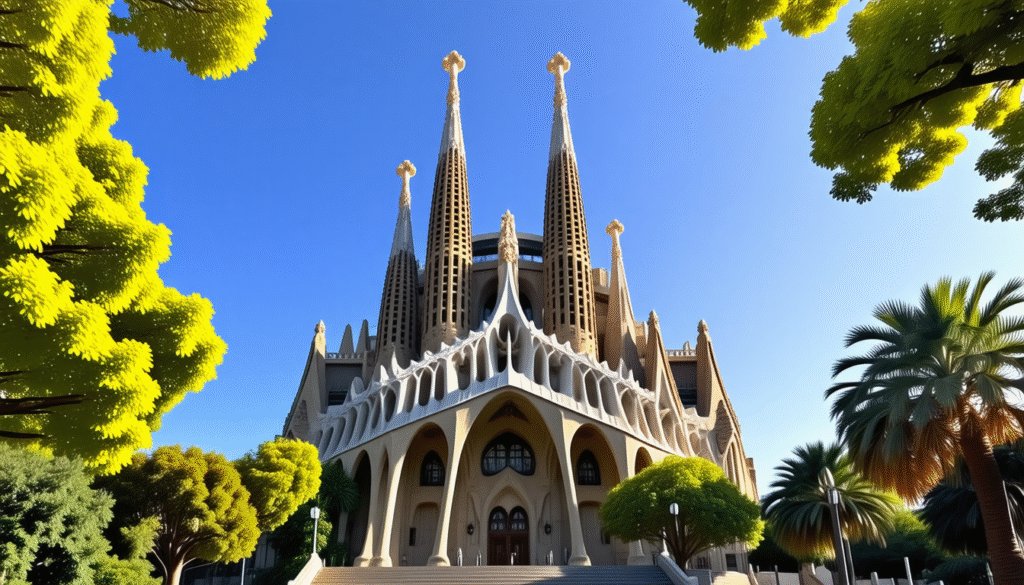
The magnificent spires of the Sagrada Família have pierced the Barcelona skyline for nearly a century and a half, weaving a narrative where architecture meets spirituality, creativity, and Catalan pride. Designed by the visionary Antoni Gaudí, this imposing Roman Catholic minor basilica transcends traditional construction, blending the sacred with the avant-garde. Starting as a modest project in 1882 to promote Christianity amid rising secularism, the Sagrada Família rapidly evolved into a monumental testament of faith and architectural innovation. Spanning well beyond Gaudí’s lifetime, the ongoing construction showcases an unyielding dedication to creating a space where nature-inspired décor and intricate symbolism unite in an Eternal Basilica.
Gaudí’s desire to break free from rigid historic styles resulted in the Sagrada Artistry—a striking fusion of Gothic and Art Nouveau enriched with Gaudi Elements that embody organic forms and hyperbolic geometries. As one explores its Sacred Facades, each tells a story reflecting biblical events while also serving as catalysts of Catalan Creations, representing both religious devotion and cultural revival. This massive structure, still growing toward its monumental completion, has become emblematic of Modernist Barcelona, a city celebrated for its impeccable artistic heritage and continual innovation.
Gaudi Designs: The Intersection of Organic Geometry and Structural Innovation
The genius of Antoni Gaudí lies not only in his artistic eye but in his groundbreaking engineering solutions. Taking over the Sagrada Família project in 1883, Gaudí transformed the initial Neo-Gothic plans into a masterwork of organic geometry. He aimed to create a building capable of standing without traditional buttresses or internal supports, leading to an innovative use of helicoidal piers and hyperboloid vaults. This approach combined rigorous structural integrity with visual fluidity, in stark contrast to rigid classical forms.
Gaudí’s fascination with nature inspired every corner of his design. Branch-like columns rise like trees, creating a forest inside the basilica flooded with natural light. The use of hyperbolic paraboloids for roofs not only enhanced stability but provided unique opportunities for natural illumination and ventilation. His incorporation of organic forms meant that the basilica feels alive, a breathing monument that lovingly mimics the intricacies of the natural world.
For example, the columns representing various trees in a forest increase in diameter as they reach the floor, mimicking natural growth patterns. This is not mere whimsy but a deliberate Gaudi Element aimed at achieving both beauty and practical support. His stunning nature-inspired décor extended to mosaic tiles reflecting the vibrant blues and greens of the Mediterranean sea, infusing spirituality with the essence of Catalan landscapes.
- Helicoidal piers to distribute weight efficiently.
- Hyperboloid vaults for aesthetic fluidity and structural stability.
- Organic forms mimicking natural elements like trees and waves.
- Mosaic tiles reflecting Mediterranean colors.
- Innovative lighting strategies through skylights and stained glass.
Gaudí’s ability to merge engineering with artistic expression redefined what a cathedral could be, turning the Sagrada Família into a breathtaking organic form studio. Even today, thousands of engineers and architects study his blueprints and models, embracing and expanding on his fearless designs.
Sacred Facades: Spiritual Narratives Etched in Stone
The three principal facades of the Sagrada Família—the Nativity, Passion, and Glory—each unfold distinct chapters of the Christian story while representing different facets of human experience and faith.
The Nativity Facade was the only one completed during Gaudí’s lifetime, boasting intricate sculptural scenes celebrating the birth of Jesus. It is exuberantly decorated in contrast to the stark Passion Facade, featuring lush natural motifs such as animals, plants, and angels that symbolize life and hope. The towers flanking this facade represent apostles Barnabas, Jude, Simon, and Matthew, standing tall to herald joyous beginnings.
In contrast, the Passion Facade embodies solemnity, reflecting the suffering and sacrifice of Christ. Designed with a more severe and angular aesthetic, the sculptures demonstrate raw emotions and pain, crafted by Josep Maria Subirachs decades after Gaudí’s death. These figures provide dramatic tension with their elongated forms and deliberately simplified geometry. The four bell towers above honor apostles James the Lesser, Bartholomew, Thomas, and Philip, echoing a spiritual march towards redemption.
The Glory Facade, destined to be the main entrance when completed, conceptualizes the spiritual journey toward divine glory. It’s organized around themes of faith, hope, and charity, emphasizing humanity’s relationship with the divine order. This facade expresses Gaudí’s vision of the cosmos and the path toward eternal salvation through symbolic portals and celestial details. While construction here is ongoing, the vision tackles the grandest theological themes with bold architectural gestures and intricate symbolism.
- Nativity Facade: Celebration of life and birth with exuberant natural motifs.
- Passion Facade: Stark representation of sacrifice and suffering.
- Glory Facade: Thematic portal dedicated to charity, faith, and hope.
- Bell towers: Each facade features apostles representing spiritual guardians.
- Sculptural contrasts: Emotional richness juxtaposed against architectural austerity.
The three facades together offer visitors a profound journey from birth to sacrifice and ultimate glory. This narrative architecture is a hallmark of Gaudí’s sacred artistry, one that invites reflection on spiritual mysteries through tactile stone.
La Sagrada Heritage: A Living Symbol of Catalonian Culture and Faith
While Gaudí’s genius is central to the basilica’s construction, its significance extends beyond architecture. The Sagrada Família has served as a potent emblem of Catalan identity and religious heritage, reflecting an intertwining of art, faith, and political revival known as Renaixensa in the late 19th and early 20th centuries.
This movement sought to rejuvenate Catalan language, culture, and political autonomy during a time when Madrid-centered governance imposed strict controls on regional expression. The Sagrada Família became the physical manifestation of Catalan resurgence, a beacon proudly proclaiming a distinct spiritual and cultural lineage. Gaudí himself was deeply committed to these ideals, embedding Catalan symbolism alongside universal Christian themes throughout the basilica.
The project’s funding was primarily fueled by donations from the local community, illustrating collective dedication to a shared sacred vision. Despite interruptions from Spanish Civil War devastations and socio-political upheaval, this passion never waned. Even after Gaudí’s tragic death in 1926 following an accident, his disciples continued the painstaking task of construction, preserving the essence of his vision.
- Renaixensa movement: Cultural and political revival in Catalonia inspiring the project.
- Community-funded: Construction supported primarily through donations.
- Symbol of Catalan pride: Combines regional identity and spiritual devotion.
- War interruptions: Spanish Civil War caused destruction of key Gaudí models.
- Continued construction: Successors keep vision alive despite challenges.
Ranking among the most visited landmarks in Spain, the Sagrada Família is also globally recognized for its artistic and spiritual resonance. It was designated a UNESCO World Heritage Site in 1984, and while consecrated in 2010, it remains a constantly evolving project, symbolizing a living heritage continuously shaped by new generations. Its designation as a minor basilica elevates it as both a pilgrimage destination and a proud testament to Catalan resilience and artistic ambition.
Modernist Barcelona: Contextualizing Gaudí’s Masterpiece amid Urban Innovation
Gaudí’s work on the Sagrada Família cannot be fully appreciated without understanding the broader milieu of Modernist Barcelona. This vibrant city at the turn of the 20th century was buzzing with artistic experimentation, forging identities through architecture, design, and urban planning. The Eixample district where the basilica proudly stands highlights this through its grid layout and stylish Modernist buildings.
Gaudí’s contributions there positioned him as a towering figure in what came to be known as Catalan Modernism, a movement deeply rooted in nature, craftsmanship, and nationalism. His contemporaries like Lluís Domènech i Montaner and Josep Puig i Cadafalch also contributed stunning buildings, creating a cohesive architectural language unique to Barcelona.
The Sagrada Família’s location on a diagonal axis within the Eixample grid emphasizes Gaudí’s creative liberty. Unlike typical east–west church orientations, it embraces the city’s geometry, standing out with its spiraling towers and tactile organic forms. Its continuous growth and adaptation reflect Barcelona’s transformation from an industrial hub into a cultural capital.
- Modernist urban planning: Eixample’s unique grid and diagonal orientation.
- Catalan Modernism: Architectural and cultural movement emphasizing nature and nationalism.
- Gaudí’s contemporaries: Other architects shaping Modernist Barcelona.
- Site orientation: Unconventional southeast-northwest alignment.
- Urban landmark: Sagrada Família’s role as a defining monument in Barcelona’s skyline.
This Modernist Barcelona context has turned the basilica into more than a religious symbol; it stands also as a benchmark for architectural innovation, cultural pride, and urban identity. Visitors not only admire its Gaudi Designs and Nature Inspired Décor but also experience its significance embedded deeply within Barcelona’s collective consciousness.
Building the Eternal Basilica: Construction Challenges and Milestones Through the Decades
Almost 150 years after its groundbreaking, the Sagrada Família remains an unfinished giant aiming to become the tallest church in the world. The ongoing construction journey, fraught with interruptions and triumphs, testifies to a remarkable blend of patience, skill, and devotion.
Gaudí envisioned eighteen towering spires, symbolizing Jesus, the Virgin Mary, the Twelve Apostles, and the four Evangelists. The tallest spire dedicated to Jesus is slated to reach a soaring height of 172 meters, a symbol of divinity reaching toward heaven. Recent progress has seen parts of this spire installed, culminating in the Sagrada Família holding the record for the tallest church worldwide in 2025.
Despite setbacks during the Spanish Civil War—which destroyed many original designs—and pauses like the COVID-19 pandemic halt in early 2020, the project has marched forward. Advanced construction technologies have been embraced to respect Gaudí’s original organic philosophy while integrating modern materials and safety methods.
- Eighteen spires: Representing key biblical figures, with Jesus’ tower as the crowning achievement.
- Construction delays: Wars, political events, and pandemics paused work multiple times.
- Technological integration: Modern 3D modeling complements Gaudí’s hand-built models.
- Community involvement: Visitor ticket sales continue to fund ongoing work.
- Projected completion: Targeted for 2026, honoring Gaudí’s centennial.
The Eternal Basilica continues to capture the imagination of millions who visit or watch its progress from afar, proving that true artistry transcends time. From the local volunteers to international architects, everyone involved embraces the challenge to complete Gaudí’s dream, leaving an everlasting legacy for future generations.