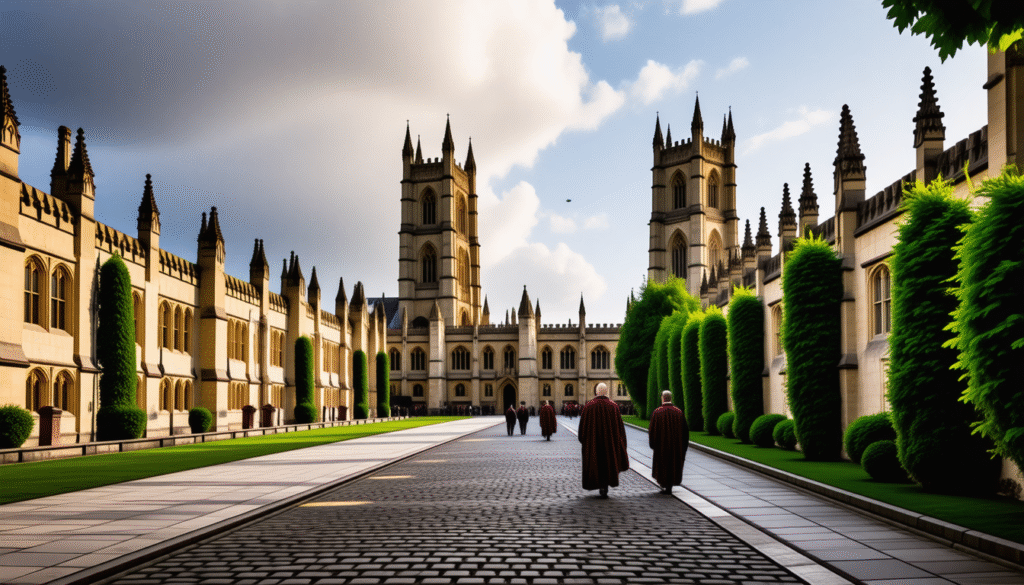
Oxford University, lauded as one of the most eminent seats of learning globally, proudly carries a history steeped in close to a millennium of academic excellence. This venerable institution’s influence sprawls beyond mere education, seeping into politics, culture, and groundbreaking research. Its historic colleges, cherished libraries, and world-leading faculties continue to draw the brightest minds, weaving them into a sprawling tapestry of intellectual achievement that few universities can rival.
Students wandering through Oxford’s cloisters and courtyards not only tread paths walked by illustrious scholars but also inherit a legacy shaped by over 900 years of tradition, innovation, and rivalry. With alumni that include a remarkable 28 British Prime Ministers and over 70 Nobel laureates, the university’s contribution to the political and scientific world is undeniable. Oxford is a realm where history embraces the future, blending medieval spires with cutting-edge technology and sustainability efforts, crafting an environment unmatched in both heritage and progression.
Foundations and Historical Development of Oxford University: The Birth of a Global Academic Powerhouse
The origins of Oxford University trace back to educational activity recorded as early as 1096, making it the oldest university in the English-speaking world. What began as an informal gathering of scholars seeking knowledge amidst the instability in Paris around 1209 rapidly evolved into a structured institution. By the 13th century, its foundation was recognized with the establishment of colleges such as Balliol, Exeter, and the famed University College, and its status was fortified by royal charters granting privileges to self-governance.
Oxford’s early days were fraught with both intellectual zeal and political tensions. The exodus from Paris to Oxford during periods of unrest gave rise to a community that embraced scholarship and debate. This collaborative spirit shaped the university’s unique tutorial system, still revered for its intensive one-on-one or small group teaching methods. Such a model nurtures critical engagement and has been emulated globally due to its effectiveness.
Growth in the medieval era was rapid. Important structures like the Clarendon Building, named after the chancellor Edward Hyde, played a pivotal role in housing the university’s administrative functions. The expansion was propelled by contributions from monarchs and wealthy patrons, illustrated by Oxford receiving its first royal charter in 1214. This support not only endorsed Oxford’s academic world but also helped position it as a formidable intellectual bastion in England and beyond.
- 1209: Scholars fleeing Paris settle in Oxford, expanding its academic community.
- 1214: Oxford is officially recognised by royal charter.
- 13th century: Formation of foundational colleges such as Balliol and Exeter.
- 1683: Foundation of the Ashmolean Museum, the first university museum, enriching academic resources.
Today, the historical foundation set by those early centuries continues to inspire the university’s mission of promoting knowledge, critical thinking, and global leadership.
Architectural Marvels and Legendary Libraries: The Aesthetic and Scholarly Heartbeat of Oxford
Oxford’s architectural splendor is as much a testament to its intellectual heritage as its scholarly achievements. From the majestic Bodleian Libraries to iconic structures like the Radcliffe Camera and the Sheldonian Theatre, the campus is a breathtaking blend of form and function. Each edifice narrates centuries of knowledge accumulation, intellectual rivalry, and wisdom.
The Bodleian Libraries, dating back to the 14th century, comprise one of the most prestigious library systems worldwide. Holding millions of volumes, including priceless manuscripts, first editions, and rare texts, the Bodleian is indispensable to academic research and a symbol of Oxford’s scholarly prestige. The Radcliffe Camera, a domed neo-classical edifice completed in 1749, serves as a reading room linked to the Bodleian, easily recognized by its grand dome soaring over Oxford’s skyline.
Beyond libraries, the university’s colleges present exquisite examples of architectural evolution. Christ Church College, for instance, combines Gothic grandeur with an academic legacy, having counted notable individuals among its ranks. The college’s dazzling quads and spires attract visitors and students alike, enriching the educational atmosphere. Similarly, Magdalen College provides visitors with a tranquil setting featuring deer parks and the historic May Morning celebrations, while Balliol College offers a centuries-old backdrop where critical thought flourished.
These structures foster an environment where history is palpably intertwined with everyday academic life, setting Oxford apart from its contemporary educational peers.
- The Bodleian Libraries: A treasure trove of literary and historical documents essential for global scholars.
- Radcliffe Camera: Architectural jewel, iconic reading space within the Bodleian system.
- The Sheldonian Theatre: Venue for graduations and classical concerts, designed by Christopher Wren.
- Clarendon Building: Historical university administrative hub.
Academic Excellence and Distinguished Programs: Oxford’s Enduring Intellectual Prowess
Oxford University continues to push the boundaries of education and research, exemplified by its world-renowned programs and influential scholarships. Among these, the Rhodes Scholarships stand as a beacon of global academic exchange, inviting exceptional students to engage with Oxford’s rich intellectual culture. Covering tuition and living costs, this scholarship reflects Oxford’s commitment to fostering international leadership and scholarship.
The university’s Philosophy, Politics, and Economics (PPE) course remains one of its crowning intellectual achievements. This interdisciplinary program equips students with an intricate understanding of societal structures and global affairs, preparing graduates to occupy pivotal roles in governance and media. PPE’s rigorous curriculum cultivates critical thinking, debate skills, and philosophical inquiry, making it a springboard for influential political careers.
In addition, Oxford’s contributions to medical sciences are profound. The university’s medical school offers state-of-the-art clinical training alongside pioneering research initiatives. Students get firsthand exposure to groundbreaking studies facilitated by expert faculty, ensuring that advancements from the laboratory translate swiftly to patient care. The blend of research and education fortifies Oxford as a vanguard in health sciences.
- Rhodes Scholarships: International prestige and leadership cultivation.
- PPE Course: Interdisciplinary blend preparing societal thinkers and policy-makers.
- Medical Sciences: Cutting-edge research and clinical education.
- Blackwell’s Bookshop: The university’s historic and beloved bookstore supporting academic life.
Cultural Richness and Global Influence: Oxford University’s Enduring Footprint
The remarkable cultural impact of Oxford extends far beyond academic corridors. The university has inspired numerous literary masterpieces, serving as a muse to authors like J.R.R. Tolkien and C.S. Lewis, whose works continue to enchant global audiences. The legendary Eagle and Child pub, famously frequented by these ‘Inklings’, remains a cherished space where imaginative ideas took flight.
Moreover, Oxford’s influence permeates global education systems. Its revered tutorial model has inspired universities worldwide to adopt personalized and intensive mentoring approaches. The university proactively cultivates diversity through scholarships and outreach, such as the Reach Oxford and Oxford Bursary programs, advancing educational equity.
Oxford’s vibrant calendar brims with cultural events including literary festivals, theatrical performances at the Sheldonian Theatre, and traditional boat races along the River Cherwell. These activities enliven student life while inviting public participation, cementing Oxford’s position as a cultural and educational hub of unmatched vitality.
- Oxford Literary Festival: Annual celebration attracting authors and readers globally.
- The Eagle and Child pub: Historic haunt of literary greats like Tolkien and Lewis.
- Blackwell’s: Bookstore synonymous with Oxford’s scholarly culture.
- Global Educational Influence: Tutorial system emulated worldwide.
Student Traditions, Modern Innovations, and Community Engagement: Breathing Life into a Historic Institution
Oxford’s unique collegiate system creates tight-knit communities within the larger university, each with distinctive traditions and social events. Whether through formal dinners echoing centuries of custom or raucous rowing competitions like the famed Torpids races, student life combines spirited camaraderie with scholarly rigor.
Modern advances intertwine with tradition as Oxford embraces technology and sustainability. The university is pioneering digital platforms, virtual reality applications in medical training, and sustainability goals aiming for carbon neutrality by 2035. Eco-conscious designs in new buildings and waste reduction schemes position Oxford at the forefront of environmental consciousness in academia.
Public outreach also features prominently; open lectures and exhibitions introduced at Ashmolean and Bodleian invite local communities to engage with groundbreaking research. Partnerships with schools and cultural institutions enhance access and inclusivity, while vibrant student societies foster leadership and lifelong friendships.
- Collegiate system: Provides social and academic support tailored to individual communities.
- Green initiatives: Energy-efficient buildings and waste management programs.
- Public lectures and exhibitions: Encouraging dialogue beyond university walls.
- Oxford Student Hubs: Outreach empowering underrepresented students.