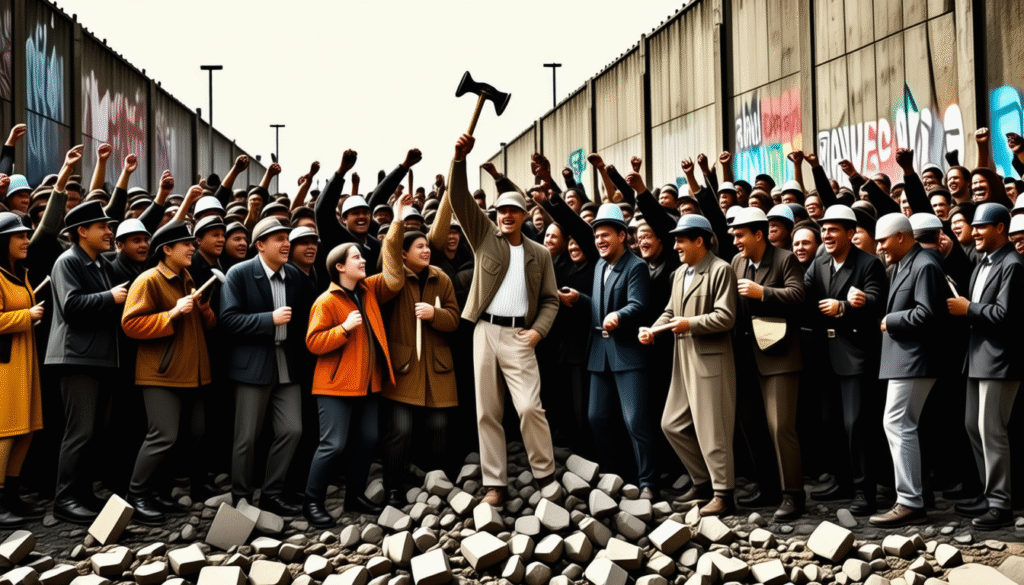
The collapse of the Berlin Wall in 1989 signified not just the physical dismantling of a concrete barrier but the profound transformation of Europe’s political landscape. For nearly three decades, the Wall functioned as the most potent symbol of the Cold War divide — a stark segregation between East and West, communism and capitalism, freedom and repression. In a world still divided by ideology and surveillance, the toppling of this structure underscored a yearning for unity and change, sparking celebrations that echoed across continents. This watershed moment captured global attention and would eventually lead to Germany’s reunification and the dissolution of the Soviet sphere’s grasp.
East Berlin, layered with checkpoints and guarded perimeters, became synonymous with division. The Wall sliced through neighborhoods, severing families and friendships, while state propaganda painted it as an “Anti-Fascist Protection Rampart.” With towering watchtowers and floodlights, the Wall was both a physical and psychological blockade engineered by the communist regime to halt the mass exodus of East Germans into the West. The Wall’s emplacement was largely a response to the staggering loss of around 3.5 million East Germans fleeing to West Germany before 1961, a brain drain crippling the Eastern bloc’s economy and morale.
Yet, the fall was not a sudden stroke of luck or a result of a single individual’s action. It was a layered culmination involving grassroots activism, diplomatic recalibrations, and evolving leadership dynamics within both Germany and the Soviet Union. The echoes of reformist rhetoric by Soviet leader Mikhail Gorbachev, notably policies like Glasnost and Perestroika, weakened the iron grip of Communist doctrine. Simultaneously, internal dissent brewed among East German citizens, with persistent public protests and civil resistance intensifying the pressure on the regime.
The international context also played a critical role. The early Eastern European revolutions of 1989, such as those in Poland and Hungary, eroded Soviet dominance and inspired confidence among East Germans. Western governments, particularly under the administration of US President Ronald Reagan and later George H.W. Bush, cautiously supported change but remained vigilant not to destabilize a fragile peace. The Berlin Wall’s fall thus emerged spectacularly on 9 November 1989, catching many by surprise when the East German government announced new, relaxed travel regulations, prompting thousands to converge at the border crossings.
How the Berlin Wall Became a Cold War Icon of Division and Oppression
The Berlin Wall was never merely a construction of concrete blocks; it represented a calculated political and ideological stratagem intended to freeze a deeply divided continent in place. Following the end of World War II, Germany’s partition into four occupation zones — controlled by the Soviets, Americans, British, and French — set the stage for this division. However, tensions quickly escalated, and Berlin, though nestled inside the Soviet sector, itself became a microcosm of Cold War rivalry.
East Germany, officially the German Democratic Republic (GDR), leaned heavily on Soviet ideology to justify its existence. By 1961, the East German leadership feared the continuing hemorrhage of citizens defecting to West Germany via Berlin’s porous borders. To staunch this flow, they erected the Berlin Wall to isolate the East from the West physically. The wall included not only a thick concrete barrier but an intricate security system of barbed wire, guard towers, mines, and a heavily patrolled death strip.
This harsh environment led to unsettling human stories of escape attempts and tragic losses. Over these years, hundreds died trying to scale or tunnel beneath the Wall, while others embarked on elaborate ruses to reach freedom. The Wall simultaneously operated as a psychological weapon, ingraining fear and submission among East Berliners and symbolizing the stark contrast between the promise of democracy and the reality of authoritarian control.
- The Wall’s Construction Date: 13 August 1961
- Length of the Wall: Approximately 155 kilometers (96 miles)
- Security Features: Guard towers, minefields, signal fences, and patrolling soldiers
- Number of Escape Attempts: Estimated over 5,000
- Fatalities: Roughly 140 people died at or near the Wall
Berlin itself embodied dual realities, with West Berlin flourishing under capitalist prosperity and East Berlin remaining shrouded in austerity under Soviet control. Cultural counterpoints emerged inside museums like the DDR Museum, illustrating everyday life under socialism, and the Trabi Museum, showcasing the iconic East German Trabant car, emblematic of the period’s economic shortages.
Grassroots Movements and Political Shifts Leading to the Fall of the Berlin Wall
The dramatic unravelling of the Berlin Wall was deeply rooted in consistent public dissent and political ferment within East Germany and the broader Eastern Bloc. Throughout the 1980s, decades of repression met a generational shift passionately demanding reform, democracy, and human rights.
Key to this wave of change were a variety of grassroots initiatives and protests in East Germany. The Peaceful Revolution gathered momentum with thousands regularly convening in towns like Leipzig, holding candlelight vigils that evolved into broad demands for open borders and political transparency. Citizens bravely staged peaceful demonstrations despite threats from the notorious Stasi secret police documented in the Stasi Museum.
Moreover, external factors catalyzed these internal pressures. Mikhail Gorbachev, assuming Soviet leadership in 1985, advocated non-interventionism in satellite states, signaling a departure from traditional Soviet suppression. His policies of glasnost, promoting openness, and perestroika, economic restructuring, emboldened reformists within East Germany and elsewhere.
A pivotal moment came in late 1989 when Hungary dismantled its border fence with Austria, the first breach in the Iron Curtain. This event unleashed a torrent of East Germans seeking Westward asylum through Hungary, rendering the Berlin Wall’s blockade increasingly untenable.
- Mass Demonstrations in Leipzig and other cities
- Stasi Surveillance Resistance increasing under public scrutiny
- Gorbachev’s Reforms encouraging liberalization and change
- Eastern European Border Openings amplifying escape routes
- Growing Media Exposure revealing regime weaknesses
Despite attempts by some hardliners to maintain the status quo, the overwhelming tide of change continued. On 9 November 1989, a miscommunicated announcement by East German official Günter Schabowski regarding travel permission triggered ecstatic crowds to approach border crossings, forcing guards to eventually open the gates. This spontaneous reaction crystalized decades of suppressed hopes into exuberant liberation.
The Role of International Diplomacy and Leadership during the Berlin Wall Collapse
While the Berlin Wall’s collapse visualizes grassroots struggle, global political dynamics significantly shaped how events unfolded and were managed. The delicate balance of power between East and West and the cautious diplomacy of key leaders influenced the course of history.
Ronald Reagan’s famous 1987 speech at the Brandenburg Gate, urging, “Mr. Gorbachev, tear down this wall!” captured the symbolic confrontation between the US and the Soviet Union. Although it was largely rhetorical, it added moral pressure on the Soviet-backed East German regime. Meanwhile, British, French, and American officials closely monitored developments, fearful that sudden upheaval might spark wider conflict during a time when nuclear tensions still simmered beneath the surface.
Simultaneously, Gorbachev’s unwillingness to use force against reform movements farther weakened hardline Communists while empowering peaceful revolutionaries. Western leaders negotiated cautiously but supported Germany’s eventual reunification diplomatically. In 1990, after months of discussions, the Treaty on the Final Settlement with Respect to Germany laid the groundwork for full sovereignty and integration into the post-Cold War order.
- Key Figures: Mikhail Gorbachev, Ronald Reagan, Helmut Kohl
- Brandenburg Gate Speech symbolic call for openness
- Diplomatic Treaties ensuring peaceful reunification
- International Fear of escalation and nuclear war prevention
- Multilateral Negotiations in Moscow, Paris, and beyond
Institutions such as the Berlin Wall Foundation and sites like Checkpoint Charlie Museum today preserve the legacy of the diplomatic tensions that once defined this era while educating visitors about the intricacies of Cold War tensions and the peace secured through dialogue.
Preserving History: Landmarks and Museums Documenting the Berlin Wall Story
As of 2025, many memorials, museums, and exhibitions throughout Berlin safeguard the narrative of the Berlin Wall, ensuring future generations grasp its historical weight and human impact.
The East Side Gallery stands as one of the longest contiguous sections of the original Wall, now draped in vibrant murals painted in 1990, symbolizing hope and freedom. Meanwhile, the Bernauer Strasse Memorial marks the site of daily confrontations and dramatic escape attempts, providing a poignant insight into the division’s tangible human cost.
Dedicated institutions such as the Mauermuseum – also known as the Checkpoint Charlie Museum – focus on the Wall’s history, escape stories, and espionage under Cold War tensions. Simultaneously, open-air displays like the Open Air Berlin Wall Exhibit provide contextual markers and educational resources that combine storytelling with tangible artifacts.
- East Side Gallery: Longest remaining wall section with murals
- Bernauer Strasse Memorial: Site of historic escapes and division
- Mauermuseum: Extensive exhibits on espionage and escapes
- Stasi Museum: Inside the secret police world
- Open Air Berlin Wall Exhibit: Outdoor historical interpretation
These landmarks attract millions of visitors annually, providing not just a glimpse into Cold War history, but also inspiring reflection on freedom and human resilience. Collaborative initiatives with Berlin Tourismus ensure this heritage is preserved and promoted responsibly, balancing education with tourism in the contemporary era.
Legacy of the Berlin Wall in Contemporary Europe and Culture
More than three decades later, the Berlin Wall’s fall remains an emblematic moment echoing throughout global history, its influence visible far beyond Germany’s borders. The sudden tearing down of this formidable division was not merely about bricks and mortar but the unleashing of human potential and the reshaping of political realities across Europe.
Contemporary Europe continually grapples with the legacy of division, political integration, and identity, concepts directly traced to the Cold War era’s shadow. The Wall’s fall paved the way for the expansion of the European Union, NATO’s new role, and deeper reconciliation processes between nations once adversaries.
Culture, too, is steeped in the Wall’s symbolism. In film, literature, and the arts, the Berlin Wall continues to inspire stories of resistance, hope, and the human spirit’s defiance. Annual commemorations affirm the collective memory, echoing through remaining Wall fragments, exhibitions, and international dialogues.
- European Integration: EU enlargement and unity initiatives
- Commemorative Events: Anniversaries and public remembrance
- Cultural Productions: Films, books, and exhibitions on the Wall
- Tourism Development: Growing interest in historical tours including the Berlin Wall Foundation and DDR Museum
- Political Lessons: Democracy and human rights awareness inspired by history
With a continued global fascination and educational projects dedicated to this historic rupture, the Berlin Wall’s fall emerges not just as a past event but an ongoing dialogue about division, reconciliation, and freedom. It stands as testimony to what change looks like when courage meets opportunity.