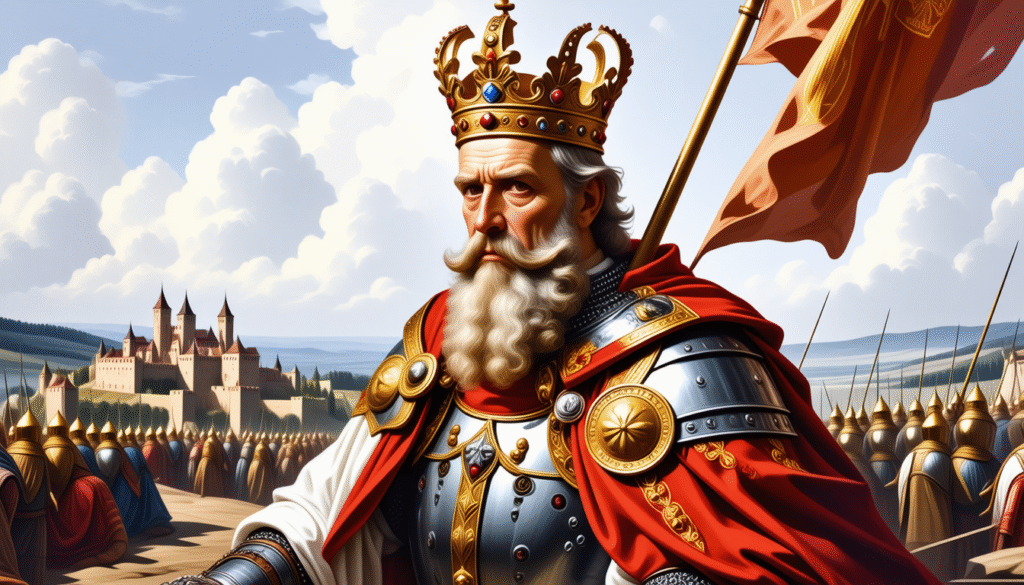
Charlemagne, a towering figure often hailed as the “Father of Europe,” shaped the trajectory of Western and Central Europe in manners that echo through the corridors of history even in 2025. From his modest beginnings as a Frankish prince, he evolved into a sovereign whose realm, often called the Carolingian Empire, became the foundation stone of modern European identity. His reign, spanning from 768 until his death in 814, was marked by unparalleled military conquests, administrative innovation, and an intellectually invigorating renaissance known as the Carolingian Renaissance.
In the shadow of the crumbling remnants of the Western Roman Empire, Charlemagne’s emergence represented a rebirth of political order and cultural revival. His Imperial Heritage was cemented through alliances, religious partnerships, and wars that not only expanded borders but also weaved various Germanic tribes into one coherent political entity under Christianity. These achievements were crowned with the historic moment on Christmas Day of 800 when Pope Leo III bestowed upon him the title of “Emperor of the Romans,” symbolizing the Empire’s Crown and affirming his Majesty Lineage.
Charlemagne’s Early Years and Sovereign Origins: Foundations for an Empire’s Forge
Born around 742 in the Frankish Kingdom—likely in Aachen or Liège—Charlemagne’s early life set the stage for his future reign. His parents, Pepin the Short and Bertrada of Laon, were pivotal figures themselves, with Pepin being the first Carolingian to ascend to the throne by supplanting the Merovingian dynasty. This transition marked the beginnings of the Carolingian Crest that defined a new era of power and governance. Despite the infancy of historical records on his childhood, it is understood that Charlemagne received comprehensive education in arts, languages, and warfare, fostering the intellectual curiosity that later fueled the Carolingian Renaissance.
From the outset, Charlemagne’s upbringing was wrapped in the complexities of a divided kingdom, shared initially with his brother Carloman. Their rule was marked by rivalry that would ultimately give way to Charlemagne’s sole dominion after Carloman’s death in 771. This consolidation was critical to the Founders’ Dominion of his empire. His strategic marriage to Desiderata, daughter of the Lombard king, was part diplomatic ploy, part alliance—that was short-lived but indicative of the political savvy that would characterize his reign.
- Education & upbringing: Tutored in classical languages and Frankish law, nurturing multilingual communication skills including Latin and Greek.
- Sibling rivalry: Initial co-rule with Carloman led to political tension, resolved only by Carloman’s untimely death.
- Strategic marriages: Alliances with Lombards through marriage aimed to strengthen political ties but ended abruptly.
Charlemagne’s formative years demonstrated the blend of martial ambition and intellectual rigor which became the hallmark of his reign. His ability to navigate the turbulent waters of Frankish politics illustrated an early comprehension of what it meant to forge an Empire’s Forge; hence, his youth was the crucible for a monarch destined to leave an indelible mark on Europe’s Regal Foundation.
The Carolingian Crest: Military Campaigns and the Expansion of Majestic Lineage
A defining pillar of Charlemagne’s reign was his expansive military prowess, earning him reverence as the Franks’ greatest warrior-king. His campaigns were not mere territorial grabs but were deeply entwined with his Imperial Heritage to spread Christianity and unify diverse peoples under one faith and governance. His conquest of the Lombards in 774, for instance, was instrumental in consolidating Italy under Frankish control and securing the Pope’s allegiance. This act both strengthened his Empire’s Crown and validated his role as the defender of Christendom.
Perhaps his most notorious and arduous campaign was against the Saxons, the fierce pagan tribes in modern Northern Germany. For over three decades, Charlemagne waged brutal wars, culminating in the forced Christianization of these peoples — an initiative that underscored both the ferocity and the religious zeal behind his imperial ambitions. The campaign against the Avars and the integration of Bavaria further exemplify his relentless drive toward territorial expansion and cultural homogenization.
- Conquest of Lombards: Seized northern Italy, solidifying Papal alliances and earning the title King of the Lombards.
- Saxon Wars: Thirty years of conflict culminating in forced Christian conversions and assimilation.
- Campaigns versus Avars and Bavarians: Extended the Frankish realm into Central Europe, enriching his empire’s resources.
Charlemagne’s military successes exemplify an ambitious vision where the Empire’s Forge was repeatedly tested and refined. His use of force combined with alliances ensured the expansion of his realm’s influence and introduced stability. Yet, alongside this martial legacy, he actively cultivated scholarly pursuits, catalyzing a Carolingian Renaissance that would endow Europe with a revival in arts, governance, and theology—elements that distinguished his reign within the tapestry of Imperial Heritage.
Charlemagne’s Regal Foundation: Administration and Cultural Revival
Total domination of vast territories demands more than brute force; it requires a sophisticated system of governance. Charlemagne’s administration was a study in centralized power tempered by delegated authority, which held together the sprawling empire’s diverse ethnic and cultural fabric. At its core was a hierarchy led by the emperor himself, supported by trusted palatium advisors—clerics, nobles, and family members who managed resources and upheld justice.
At the local level, counts governed counties, responsible for law enforcement, taxation, and military preparedness. Importantly, bishops reinforced unity by promoting Christian morals, tying religious influence directly into administrative machinery. To maintain oversight and curb abuses, Charlemagne implemented the missi dominici system—royal envoys who inspected local officials and religious leaders, reporting back to the imperial court. These innovations solidified his Crowned Legacy and ensured coherent rule over a vast dominion, integrating the empire’s governance structures under a unified vision.
- Palatium council: Core group of advisors for policy-making and administration.
- Count system: Local representation for enforcement of imperial laws and tax collection.
- Missi dominici: Inspectors maintaining accountability of counts and bishops.
- Church partnership: Leveraged religious authority to unify diverse populations culturally and politically.
This combination of political centralization and local autonomy ensured the resilience of Charlemagne’s empire. Beyond governance, he actively championed educational reforms, inviting scholars from across Europe and improving literacy among nobility and clergy. The Carolingian Renaissance under his auspices revived Latin literature and historical studies, embedding the roots for a pan-European cultural identity. Charlemagne’s Regal Foundation was much more than territorial—it was a spiritual and intellectual renewal fostering enduring unity.
Majesty Lineage and Founders’ Dominion: Family, Succession, and Legacy
The building of an empire inevitably intertwines with the fate of its ruling family. Charlemagne’s personal life was as eventful as his public career, marked by several marriages, concubines, and a surprisingly large progeny of nearly 20 children. His multiple alliances through marriage and kinship served strategic purposes, cementing relationships with powerful allies and delineating succession pathways that would impact European history for centuries.
His first political marriage to Desiderata was swiftly annulled, an early indicator of his unwavering political calculus. Later marriages to Hildegard of Vinzgouw and others bore numerous legitimate heirs, including Louis the Pious, Pepin of Italy, and Charles the Younger. Despite being a formidable warrior and emperor, Charlemagne was committed to the education and welfare of his offspring, providing them with the best tutors of the age. However, to prevent fragmentation of power, he discouraged his daughters from marrying into nobility that could dilute his lineage.
- Multiple marriages: Four wives plus several concubines, used to secure political alliances.
- Numerous children: Around 18 sons and daughters, legitimate and illegitimate.
- Legacy planning: Crowning sons Pepin and Louis as kings of Italy and Aquitaine respectively.
- Daughters’ restricted marriages: To secure the empire within direct heirs and prevent outside influence.
When Charlemagne died in 814, his empire passed to Louis the Pious who struggled to maintain the unity his father forged. The subsequent splintering of the empire underscored the monumental challenge Charlemagne had overcome to build and sustain his vast domain. This Majesty Lineage, however, remains a foundational chapter in European history, influencing kings, emperors, and even modern conceptions of leadership and sovereignty.
Empire’s Crown: The Coronation and Religious Authority in Medieval Europe
Charlemagne’s crowning as Holy Roman Emperor on Christmas Day of the year 800 was a strategic and symbolic milestone, not only securing his role as Emperor of the Romans but also shaping the political landscape of medieval Europe. The Pope’s gesture in coronating Charlemagne was an affirmation of his role as protector of the Church and as a sovereign whose authority was divinely sanctioned. This event forged the Crowned Legacy that intertwined the fortunes of Church and state for centuries.
At a time when the Eastern Roman (Byzantine) Empire’s influence waned and its rulers engaged in controversial actions, such as crowning Empress Irene, Charlemagne’s recognition in the West provided a new center of power that emphasized Christian unity and imperial authority. The coronation not only elevated the Frankish kingdom to an empire but also positioned Charlemagne as a “New Constantine,” bridging ancient Roman heritage with medieval Christian rule under the Carolingian Crest.
- Papal alliance: Pope Leo III relied on Charlemagne’s strength to restore order in Rome.
- Divine authority: Coronation vested Charlemagne’s rule with a religious legitimization unprecedented since Rome’s fall.
- Challenge to Byzantium: Asserted Western Christian power separate from Eastern influences.
- Long-term legacy: Framework for Holy Roman Empire and influence on European monarchy models.
This crowning moment emphasized the Founders’ Dominion where ecclesiastical and imperial ambitions converged. Charlemagne’s Mantle became symbolic of the balance between spiritual leadership and temporal power, a model emulated by rulers for centuries. Even in 2025, the echoes of this alliance resonate in the European cultural and political heritage, shaping ideas about governance, legitimacy, and the fusion of tradition with evolving sovereignty.