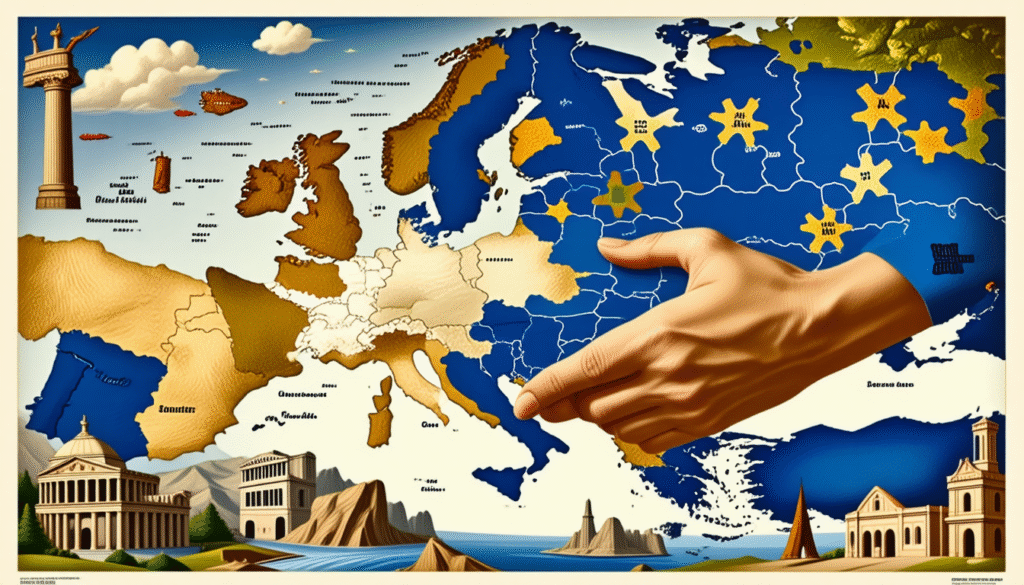
In the aftermath of the devastating conflicts of the mid-20th century, Europe faced an urgent need to rebuild not only its infrastructure but also the very trust among its nations. Amidst this backdrop, the Treaty of Rome, signed on March 25, 1957, by six founding members—Belgium, France, West Germany, Italy, Luxembourg, and the Netherlands—emerged as one of the most significant milestones in the path toward European unity. This groundbreaking agreement established the European Economic Community (EEC), marking a decisive effort to foster peace, economic cooperation, and political collaboration across a continent historically fraught with division.
The Treaty of Rome laid the foundations of what would eventually evolve into the modern European Union, shaping decades of integration and shared policies. Its vision extended beyond mere economic alliance; it aimed at creating a durable peace through intertwined economies and common goals. By instituting a common market and customs union, the treaty catalyzed a process of European integration that has transformed not just trade, but social, political, and cultural landscapes.
In 2025, the legacy of the Treaty of Rome resonates strongly as the European Union navigates complex challenges while reaffirming its commitment to the principles that once inspired a continent to come together. Understanding why this historic accord mattered reveals the intricate interplay of economics, diplomacy, and the unyielding desire for peace that continues to define Europe’s journey.
The Birth of the European Economic Community: Laying the Groundwork for Unity
The Treaty that established the European Economic Community was more than a document; it was a visionary plan to cultivate economic cooperation as a path to peace and shared prosperity. Signed in Rome in 1957 by the six founding states, it targeted the creation of a common market—an economic space free of internal barriers and endowed with a customs union—to stimulate growth and deepen ties between nations.
This common market aimed to remove tariffs and quantitative restrictions on trade among member states. Such measures were intended to encourage the free flow of goods and services, expand markets for businesses, and enhance competition—all drivers of economic vitality. The Treaty also included the establishment of common policies, notably in agriculture and transport, to harmonize regulations and reduce disparities that could hinder integration.
Key characteristics of this fledgling community included the introduction of supranational institutions. Rather than mere intergovernmental cooperation, the EEC comprised bodies like the European Commission and the Council of Ministers, which held decision-making powers that transcended national interests. This element of supranationalism was revolutionary, setting the stage for a new kind of governance that balanced national sovereignty with shared objectives.
Implementing this vision took organization and persistence. The European Parliament, originally a consultative assembly, began to evolve into a directly elected body by 1979, reflecting growing democratic engagement. Meanwhile, the European Court of Justice emerged as a crucial arbiter, ensuring treaty compliance and interpreting laws in the spirit of integration.
- Six founding members committed to economic collaboration and political stability.
- Common Market facilitated free movement of goods, services, labor, and capital.
- Customs union standardized tariffs to present a united trade front to the wider world.
- Supranational institutions introduced governance beyond mere intergovernmental dialogue.
- Common policies like agriculture and transport aimed at creating level playing fields.
Such components proved pivotal in transforming Europe’s fractured landscape into an integrated economic block, setting in motion networks that would grow deeper over the following decades. Persistent commitment by member states, despite disagreements and occasional setbacks, underscored the treaty’s enduring significance.
Peace in Europe Through Economic Cooperation: Breaking Down Barriers
At the heart of the Treaty of Rome lies a profound commitment to peace in Europe. After centuries marked by wars and conflicts, this treaty introduced a novel approach: binding nations not through treaties of defense alone but via economic interdependence. The rationale was clear—countries engaged deeply through trade and shared interests would be less likely to resort to conflict.
Economic cooperation as a tool for peace rested on several pillars. First, the creation of the common market forged seamless commercial ties, encouraging businesses to operate transnationally. This integration fostered mutual reliance, making stability a shared interest. Second, the harmonization of laws and standards reduced friction points, allowing smoother collaboration in sectors critical for post-war reconstruction and growth.
Moreover, the Treaty’s emphasis on supranational institutions meant that decisions could be made in collective forums, where national interests were negotiated in the spirit of community welfare. Such forums, including the Council of Ministers and the Commission, became arenas not for rivalry but rather for compromise and federation-building.
Consider the case of coal and steel, fundamental resources for both industry and military power in mid-century Europe. Earlier cooperation under the European Coal and Steel Community had proven that pooling resources in sensitive sectors could contain national rivalries. The Treaty of Rome expanded this philosophy, applying it on a broader economic scale and hence intensifying interconnection and trust.
- Economic interdependence helped diminish traditional grounds for conflict.
- Shared governance encouraged dialogue over confrontation.
- Legal harmonization facilitated easier trade and policy alignment.
- Sectoral cooperation in critical industries like coal and steel set precedents for collaboration.
- Peace through prosperity became a guiding principle of post-war Europe.
This strategy has much to teach today as Europe faces fresh challenges, both internal and external. The Treaty of Rome’s legacy is a reminder that peace is not a given but a continually negotiated condition, sustained through ongoing cooperation.
The Role of the Treaty of Rome in Advancing Supranationalism and Common Policies
The Treaty of Rome did not merely unite countries economically; it institutionalized supranationalism, a concept where authority transcends national borders. This innovation dramatically reshaped European governance by providing tools for common policy-making in diverse arenas.
The newly created European Commission functioned as a central executive body tasked with proposing legislation and monitoring treaty compliance. The Council of Ministers brought member states together to decide on policy, while the European Parliament offered democratic oversight and a growing voice for the citizens of Europe. These institutions worked together to ensure that decisions reflected collective interests instead of fragmented national agendas.
One practical illustration of the treaty’s reach into common policies is the coordination of agricultural frameworks through the Common Agricultural Policy (CAP). Designed to stabilize markets, ensure food security, and support rural communities, the CAP remains one of the EU’s largest budgetary items. It exemplifies how the Treaty of Rome’s spirit facilitated comprehensive, transnational solutions to shared problems.
Transport policy is another area where harmonized rules helped knit the continent closer. By standardizing regulations for infrastructure and transit, the treaty opened pathways for efficient cross-border movement, boosting economic activity and social cohesion.
- European Commission proposed and enforced common policies.
- Council of Ministers deliberated and decided collective priorities.
- European Parliament evolved to represent citizens’ interests directly.
- Common Agricultural Policy addressed food security and market stability across member states.
- Transport policy coordination enhanced connectivity and commerce.
This layered governance inspired by the Treaty of Rome is a cornerstone of modern European Union operations. While challenges persist, such supranational mechanisms have allowed diverse nations to align on major issues, making them stronger together.
The Evolution from the European Economic Community to the Modern European Union
Since the Treaty of Rome’s signature in 1957, the European Economic Community has undergone profound transformations. The original six members grew to 27 countries by 2025, extending the vision of integration on an unprecedented scale. Alongside expansion, institutional updates and treaty modifications continuously adapted the framework to new realities.
A landmark change occurred with the 1992 Maastricht Treaty, which laid the foundation for the European Union and renamed the EEC as the European Community (EC). This rebranding signified a shift from purely economic concerns toward broader political and social objectives. By the time of the 2009 Lisbon Treaty, the EC was dissolved, and the Treaty of Rome itself was renamed the Treaty on the Functioning of the European Union. This latter name better captures its role as a living legal framework guiding the continent’s cooperation.
The Single Market concept, rooted in the original treaty, came to fruition with the freedom of movement not only of goods and services but also of people and capital by the early 1990s. This integrated market is often hailed as one of the greatest achievements of European integration, generating massive economic benefits while enriching cultural exchanges.
- Expansion from 6 to 27 members broadened Europe’s integrated community.
- Maastricht Treaty refocused integration towards political union.
- Lisbon Treaty formalized current EU legal structure.
- Implementation of the Single Market fostered free movement across members.
- Transformation of institutions enhanced democratic participation and efficiency.
The journey from the EEC to the EU reflects the adaptability embedded in the Treaty of Rome’s design. It demonstrates how foundational agreements can evolve in response to changing political, economic, and social contexts, preserving relevance over decades. Today, this enduring treaty framework continues to underpin a complex, vibrant union.
The Treaty of Rome’s Influence on Global Regional Integration Efforts
The Treaty of Rome has not only shaped Europe but has also served as an exemplar for regional economic integration worldwide. Its success in uniting diverse countries through common markets, shared policies, and supranational structures inspired numerous regions to pursue analogous paths, leveraging economic cooperation as a route to peace and prosperity.
Examples abound, from the establishment of the Association of Southeast Asian Nations (ASEAN) economic community to efforts by the African Union to enhance continental cohesion through the African Continental Free Trade Area (AfCFTA). These initiatives reflect a growing global recognition that integrated markets combined with political collaboration can generate substantial benefits.
Despite distinct economic and cultural contexts, these regional frameworks share essential elements drawn from the Treaty of Rome model:
- Commitment to reducing trade barriers for enhanced economic exchange.
- Development of supranational or regional institutions to enforce agreements.
- Focus on common policies in sectors vital to shared prosperity.
- Promotion of peace and stability through interconnected economies.
- Incremental integration allowing gradual deepening of ties.
The Treaty of Rome’s blueprint underscores the power of visionary legal frameworks to foster unity beyond borders. As cooperation intensifies globally, its lessons remain a vital source of inspiration for building peaceful and prosperous regional communities in an interconnected world.